The Silent Sales Pitch: Selling AI Through a Privacy Minefield
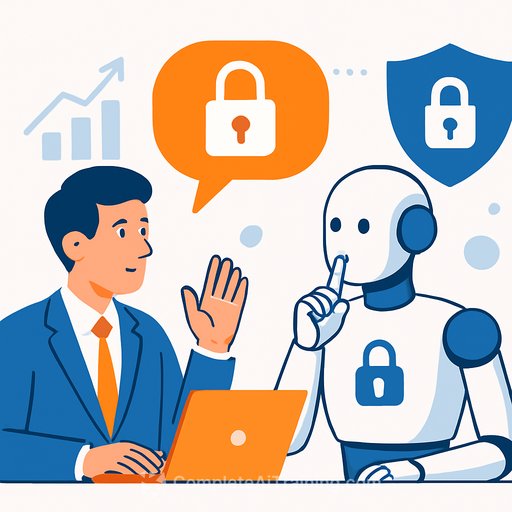
AI used to be the showstopper in demos. Now it's the quiet part. Sales leaders are trimming technical details and leaning on outcomes because one stray comment about data use can blow up a deal.
Alex Thompson, a veteran rep at a major software firm, put it simply: "I used to go deep on how our AI analyzes user data. Now, I keep it surface-level. The risks are just too high."
Why reps are holding back
Deals stall when buyers hear anything that smells like unlimited data access or murky retention. High-profile breaches and courtroom losses made AI's appetite for data look like a liability, not an edge.
Prospects have learned the right questions to ask. One client pressed Thompson on retention windows and secondary use, and the deal nearly fell apart. Transparency is still good-careless specificity is not.
The regulatory tightrope tightens
Federal efforts to unify AI rules clashed with tougher state laws, so reps face a patchwork. Some guidance aims to preempt state-by-state chaos, but it hasn't settled the debate over how much user privacy is actually protected.
States like California and Colorado now expect businesses to track data flows in granular detail. Vague pitches aren't laziness; they're risk control while legal goalposts move.
Data hunger meets user backlash
Buyers read the headlines. Tools scrape massive datasets, and people worry their interactions become training material. Community posts amplify that fear, and reps feel it in every discovery call.
Security incidents such as the MOVEit breach made security assurances table stakes. Many reps now demo only with anonymized examples and avoid real-time inputs that could expose policy gaps.
Meanwhile, AI agents that handle bookings, purchases, and inboxes raise new concerns about access to personal data. A recent piece in Wired warned that agents can reach far beyond public web data, which pushes sellers to balance excitement with restraint. Read more.
The privacy-first sales playbook
- Lead with outcomes: Quantify time saved, error reduction, or revenue impact. Keep model internals brief unless security and legal are present.
- State clear boundaries: Default to no PII in training. Opt-in required for any customer-specific learning. Explicit retention windows.
- Show controls: On/off switches for logging, redaction, role-based access, and local/tenant-isolated modes.
- Proof beats promises: Reference SOC 2, ISO 27001, external pen tests, and recent audit dates. Offer read-only trials when possible.
- Safe pilot structure: Synthetic or masked data, time-boxed access, least privilege, documented DPA, and success criteria agreed upfront.
Scripts you can use
- "Does your AI train on our data?"
"By default, no. Your data stays partitioned for your use. If you want model tuning, it's opt-in under a DPA with strict scope, retention limits, and rollback." - "Where is data stored and for how long?"
"Data stays in-region based on your selection (e.g., EU/US). Retention is X days by default, configurable to your policy, with hard deletes on request." - "Do your agents need admin access?"
"No. We use least-privilege roles and scoped tokens. If elevated access is required for a specific task, it's time-bound, logged, and approved."
Demo hygiene checklist
- Use synthetic or masked datasets. Never live PII.
- Disable persistent logs where possible during demos.
- Rotate API keys and clear temporary caches post-demo.
- Show the controls screen: user consent, retention, export/delete.
- Record approvals if the session is being captured.
What to surface early in discovery
- Regulatory posture: CPRA/Colorado compliance, cross-border transfers, vendor subprocessor list.
- Security: Encryption at rest/in transit, SSO/MFA, audit logs, breach response SLAs.
- Agent permissions: Exact scopes, data boundaries, and human-in-the-loop checkpoints.
- Data lifecycle: Retention defaults, deletion timelines, customer export rights.
- Third-party validation: Recent audits or certifications and how often they're renewed.
Why this approach protects pipeline
Buyers want outcomes and control. When you lead with benefits and show guardrails, legal doesn't hit the brakes as hard. You reduce surprises, shorten review cycles, and keep security from rewriting your pitch at the eleventh hour.
Yes, some deals slow as clients request audits. That's the cost of selling AI in 2025. But it's still less painful than concessions made after a privacy scare.
Signals from the market
Industry chatter reflects fatigue with overhyped AI and a push for dependable results. Costs dropped for advanced reasoning models, but "slop" in outputs cooled the noise. Reps who stick to proven, privacy-respecting use cases are winning more consistent business.
Concern over AI's social impact, including mental health issues, keeps trust front and center. The smarter play: fewer big promises, more controlled wins.
What's next for sellers
- More unified guardrails, slowly: Federal guidance may firm up, but state-level rules will still matter.
- Privacy-enhancing tech in the stack: Expect built-in redaction, policy enforcement, and auditability by default.
- Cleaner demos: Sandboxes that mirror production without exposing sensitive flows.
- Governance as a feature: Buyers will compare vendors on transparency dashboards and deletion controls as much as features.
One resource worth your time
The Cloud Security Alliance's work on AI risk and governance can help align your talk track with what security teams expect. Explore CSA.
If you want structured enablement on AI for sales, including privacy-first workflows and talk tracks, see our AI for Sales resources or curated training by job role at Complete AI Training.
Bottom line
The silent sales pitch isn't about hiding. It's about earning trust before earning usage. Keep the value clear, the controls visible, and the data story simple-and you'll win without stepping on privacy landmines.
Your membership also unlocks: