AI-driven operations take center stage as enterprises shift to proactive intelligence
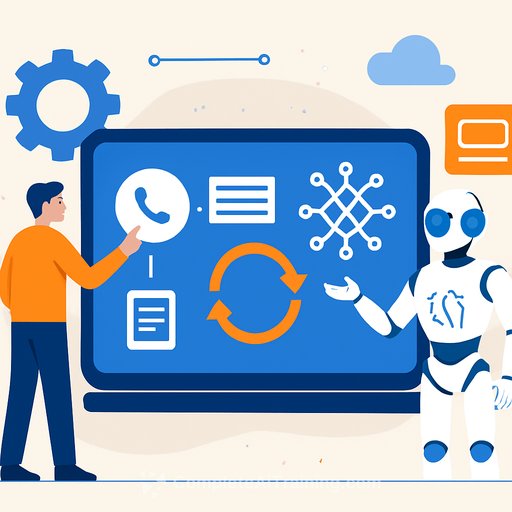
Operations teams are moving from firefighting to foresight. Agentic AI platforms are becoming part of daily work, not an experiment on the side. The priority is clear: reduce complexity so AI can produce consistent, measurable outcomes.
As Satyan Raju, chief development officer at Fabrix.ai, put it, most enterprises still depend on too many disconnected tools across observability, ITSM and automation. That tool sprawl blocks end-to-end visibility and slows decisions when seconds matter.
Why tool sprawl is your biggest tax
Disconnected systems mean duplicate alerts, slow handoffs and unclear ownership. The fix isn't "more AI"; it's a simpler operating fabric with fewer moving parts and shared context across teams.
- Map your incident-to-resolution chain and remove redundant platforms.
- Unify telemetry and tickets under a single context graph that agents and humans use.
- Standardize automations into reusable runbooks with versioning and audit trails.
- Define SLOs between tools (alerts, enrichment, tickets, remediation) so gaps are visible.
- Pick platforms with integration-first design to cut custom glue code.
What to measure now: AI KPIs that matter
Tejo Prayaga, VP of product management at Fabrix.ai, noted that AI adoption itself is now a KPI. Teams are tracking how often AI agents are invoked, how frequently their recommendations are accepted and where trust is rising or stalling.
- RCA assist acceptance rate (% of AI recommendations adopted).
- Agent invocation rate per incident, by team and by severity.
- AI accuracy for diagnosis and remediation suggestions.
- Cost per AI action (tokens, compute) and budget adherence.
- Latency from alert to actionable recommendation.
- MTTR delta with AI vs. without AI.
- Automated runbook coverage for top incident classes.
Treat your AI like any production system: instrument it, budget it and tie the numbers to real outcomes-faster resolution, lower costs and better customer experience.
Building trust in automation
According to Raju, the organizations that win define outcomes upfront and build trust deliberately. Executive commitment matters, but the day-to-day trust is earned through safe automation that proves itself.
- Start with low-risk, high-frequency actions (enrichment, diagnostics, ticket hygiene).
- Run agents in "suggest" mode first; move to partial and then full auto with guardrails.
- Use approval thresholds by severity and environment (dev, staging, prod).
- Enable audit, replay and drift detection on all automated changes.
- Hold post-incident reviews that score agent recommendations and outcomes.
- Adopt an AI risk framework for governance and transparency (NIST AI RMF).
From single agents to a full-stack fabric
Fabrix.ai's first phase focused on making it easy to create and manage agents. Next comes depth (more capable agents) and reach (more integrations and vertical use cases). The goal: a connected ecosystem that meets ops where it works.
Strategic partners such as IBM Consulting and InfoShare Systems emphasized the same direction: AI-driven operations grounded in AIOps, IT automation and DevSecOps practices. For a primer on the approach, see IBM's AIOps overview.
A simple adoption path for Ops leaders
- Pick three use cases: RCA assist on P1 incidents, ticket summarization and noisy alert suppression.
- Unify telemetry (logs, metrics, traces) and service maps into a shared context layer.
- Select an agentic platform with strong ITSM, CI/CD and cloud integrations.
- Define 6-8 KPIs (acceptance rate, MTTR delta, cost per action, latency) with targets.
- Set governance: human-in-the-loop stages, approval policies, audit, security reviews.
- Pilot in one domain (e.g., payments, checkout, data pipeline) and expand by blast-radius.
- Codify learnings into versioned runbooks and reusable automations.
- Review monthly: cut unused tools, renegotiate licenses and reinvest savings in automation.
Scorecard you can use next sprint
- AI suggestion acceptance rate: ____%
- Agent usage per incident (P1/P2): ____ / ____
- MTTR improvement with AI: ____%
- Latency to first actionable suggestion: ____ seconds
- Cost per AI-assisted incident: $____
- Automated runbook coverage (Top 10 incident types): ____%
- False-positive reduction in alerting: ____%
What success looks like
Prayaga highlighted a pattern across teams: shared context speeds decisions and reduces noise. When AI is treated as an embedded teammate-not a bolt-on-productivity and confidence rise across NOC, SRE and app teams.
Raju underscored the mindset: define success, track it and build trust step by step. Do that, and AI moves from reactive bandaid to proactive advantage.
Event note and disclosure
This perspective was shared during the "Agentic AI Unleashed: The Future of Digital & IT Operations" broadcast on theCUBE, featuring leaders from Fabrix.ai, ZK Research, IBM Consulting and InfoShare Systems. TheCUBE is a paid media partner for the event; sponsors do not have editorial control over theCUBE's or SiliconANGLE's content.
Upskill your team
If you're formalizing AI automation skills across Operations, consider this practical program: AI Certification for AI Automation. Keep the momentum by aligning training to the scorecard you track.
Your membership also unlocks: