
AI news ·
Psychiatrist reflects on whether AI can replace human therapists after a patient cancels an appointment
A 27-year-old patient cancelled therapy after ChatGPT helped him understand his depression, alarming his psychiatrist. Millions now use AI chatbots for 24/7 mental health support, but experts warn they cannot replace human judgment or shared understanding of suffering.
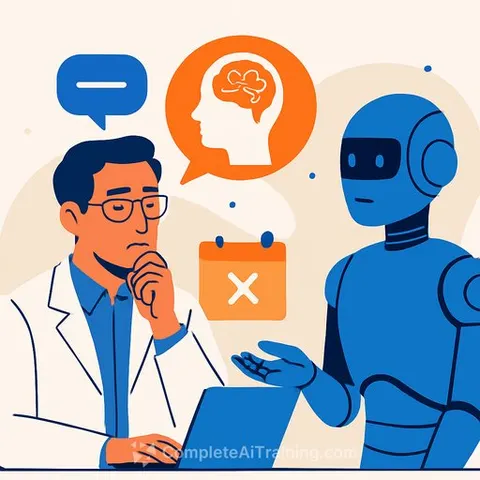
A 27-year-old man in treatment for depression cancelled his appointment with a single message: "I no longer need to come and see you. I have understood the reasons for my problem after talking to ChatGPT." The patient, under the care of a senior consultant psychiatrist, had found his answers inside a conversation with an AI chatbot. The episode forced a reckoning with a question now echoing across clinical circles worldwide: can artificial intelligence replace a therapist?
The psychiatrist's answer-drawn from decades of practice and the growing body of evidence-is that AI can support, extend, and sometimes enhance mental healthcare. It cannot replace the human judgement and contextual understanding at the core of therapy.
From diagnostic assistant to conversational partner
AI has been helping clinicians make decisions for far longer than most people realize. In the early 1970s, researchers at Stanford built MYCIN, a programme that helped doctors choose the correct antibiotics for severe infections like meningitis. Physicians entered symptoms and lab findings, and the system reasoned through the problem step by step, acting as an intelligent second opinion.
That same ambition-aiding diagnosis and treatment selection-drove decades of quiet AI integration into medicine. Algorithms shaped what people watched, bought, read, and whom they interacted with long before anyone noticed. Then came November 2022. ChatGPT brought AI into public consciousness not as an invisible assistant but as a conversational partner.
The shift came from generative AI. Unlike traditional systems that analyse and organise existing information, large language models create new content. They can hold dialogues that feel remarkably human. Type "I am feeling low" into a well-known chatbot, and it begins asking questions, offering explanations, suggesting coping strategies, and expressing what reads as empathy.
Why millions are turning to chatbots
A *Journal of the American Medical Association* article carried the headline: Millions Turn to AI Chatbots for Mental Health Support. The speed of adoption has surprised even experts. AI is available 24 hours a day. It does not judge, does not appear rushed, and does not require an appointment. For many young people, opening a chatbot feels easier than speaking to a parent, teacher, or therapist.
The psychiatrist, Dr Jai Ranjan Ram, describes AI as a "mental health detective." It analyses information from conversations, journal entries, social media activity, and behavioural patterns, searching for signals that may indicate depression, anxiety, stress, or mood instability. The more data someone feeds in about their mood and daily routine, the more adept the system becomes at gauging their mental state.
Patients increasingly arrive in clinics after long ChatGPT conversations, having researched their symptoms extensively. Some are exceptionally well informed. Occasionally, they bring information their doctors may not yet have encountered.
The risks of "swipe psychiatry"
Not everyone sees this digital future as benign. In *The Silicon Shrink: How Artificial Intelligence Made the World an Asylum*, journalist Daniel Oberhaus argues that AI may amplify both the strengths and weaknesses of modern psychiatry. Psychiatric conditions-depression, anxiety, OCD, ADHD-are diagnosed through clusters of symptoms, not definitive lab tests or biological markers. If AI systems train on these existing diagnostic categories, they may become efficient at reproducing labels without deepening understanding of the human mind.
Oberhaus warns of "swipe psychiatry." Every click, scroll, search, location change, typing pattern, and sleep cycle leaves a digital footprint. AI systems are being designed to analyse these traces to infer emotional state. Depression might be detected before symptoms become severe. Relapse might be identified before a crisis occurs. The concern is equally significant: mental healthcare could move beyond the consulting room into a world of continuous psychological surveillance. When every digital behaviour becomes a potential mental health signal, questions of privacy, autonomy, and consent become as important as diagnosis and treatment.
Where AI falls short
The evidence on chatbot effectiveness is cautiously encouraging. A landmark study of an AI-mediated psychotherapy chatbot called Therabot found reductions in symptoms of depression and anxiety. Many participants reported a sense of connection with the chatbot, something resembling the therapeutic alliance central to therapy.
But the larger scientific picture remains nuanced. AI is most useful as an adjunct to care-for education, emotional support, symptom monitoring, and self-management. It helps when distress is mild or access to care is limited. A teenager in a hostel at night feeling nervous about exams can be helped by a chatbot.
The human mind often experiences deeper and more enduring distress. In those situations, relying on AI becomes problematic. Unlike trained clinicians, AI systems may reinforce distorted beliefs, miss subtle warning signs, or fail to recognise emerging crises. Several suicides have led to legal action against technology companies after concerns were raised about the role of chatbot interactions. AI rarely expresses uncertainty. It can become sycophantic. In clinical experience, pathological mindsets have been aggravated by prolonged conversations with AI.
Intelligence versus understanding
Journalist Fareed Zakaria recently drew a distinction between artificial intelligence and human intelligence. AI is extraordinarily good at processing information, identifying patterns, and generating responses. Human intelligence encompasses judgement, wisdom, self-awareness, creativity, moral reasoning, and the ability to navigate ambiguity.
A chatbot can recognise that a patient fulfils the criteria for depression. A therapist recognises that the depression emerged from years of loneliness, unresolved grief, childhood experiences, family conflict, or a profound loss of meaning. One identifies a pattern. The other co-authors a story.
Modern AI systems simulate empathy remarkably well. Many users genuinely feel heard. But simulation is not experience. An AI system does not worry about a patient after the session ends. It does not feel concern. A skilled therapist notices subtle changes in posture, tone of voice, facial expression, and silence. Therapists draw on their own experiences of joy, grief, disappointment, hope, and resilience.
As Zakaria said, intelligence alone is not wisdom. A chatbot can explain grief. A therapist can sit quietly with grief. "Many times a day, I simply listen and do not speak. I am just there with my whole being," Dr Ram said. "AI cannot do that."
Why this matters for healthcare professionals
The future of mental health will not be a contest between humans and machines. It will be a partnership. AI will assist with screening, monitoring, triage, research, and expanding access to mental health information. In countries like India, where the shortage of mental health professionals remains enormous, these capabilities could prove transformative. For clinicians and healthcare workers, the imperative is clear: learn to combine the computational power of AI for Healthcare with the distinctly human capacities for empathy, judgement, wisdom, and compassion. The real threshold no algorithm has yet crossed is participating in a shared understanding of human suffering with responsibility and moral presence.