
AI news ·
Pudu Robotics and Shenzhen CTID partner to build fully robot-staffed hotel on Shenzhen-Zhongshan Link
Pudu Robotics is building what it calls the world's first fully robot-staffed hotel, set to open on a Shenzhen artificial island by late 2026. Robots will handle check-in, cleaning, food service, and deliveries using a shared AI system.
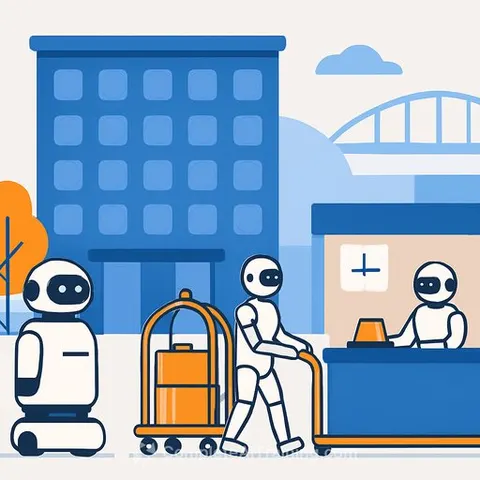
Chinese Robotics Firm Plans World's First Full-Service Robot Hotel by Late 2026
Pudu Robotics and Shenzhen Culture & Tourism Industry Development Co. Ltd have signed an agreement to build a hotel where robots handle guest reception, room delivery, cleaning, food service, and support across all operations. Trial service begins late 2026 on the West Artificial Island of the Shenzhen-Zhongshan Link, a major infrastructure project in China's Guangdong-Hong Kong-Macao Greater Bay Area.
The project represents one of the largest real-world deployments of robots in hospitality. Rather than isolated automation tools, the hotel will operate as a connected ecosystem where different robot types work together using shared AI capabilities.
How the Robot Network Operates
The hotel's robots run on Pudu's embodied intelligence foundation model, PuduFM 1.0, and its general embodied AI agent platform, PuduAgent. The system uses Vision-Language-Action models and world-model-driven navigation to let different robots share the same intelligence framework.
A reception robot can understand gestures and social cues. A delivery robot optimizes routes autonomously. A cleaning robot adapts to changing environments. All three draw from the same core AI, allowing knowledge to transfer across robot categories.
Pudu has shipped over 130,000 robots globally across 85 countries and regions. Its product lines include service delivery, commercial cleaning, industrial delivery, and general embodied AI systems.
What Guests Will Experience
During a demonstration at the signing ceremony, Pudu showed how its robots would function in the hotel. The PUDU T300 handled 300-kilogram luggage loads and operated elevators independently. The PUDU CC1 Pro and PUDU MT1 cleaning robots performed real-time floor maintenance with AI-native waste detection.
BellaBot Pro served coffee with voice interaction and lighting effects. KettyBot Pro delivered refreshments while displaying event information. FlashBot's vending system retrieved and delivered beverages following mobile orders.
The phased rollout begins this year, with selected guest rooms and robot services opening to the public by the end of 2026. The companies plan to expand capabilities through 2030.
What This Means for Hotels
The project tests whether robots can handle an entire guest journey rather than isolated tasks. Success here could shape how hotels across the industry approach staffing and service delivery.
For hospitality professionals, the hotel serves as a working laboratory for understanding how multiple robot types integrate into daily operations-from back-of-house logistics to guest-facing interactions. The data and operational lessons from late 2026 onward will likely influence decisions at other properties.
Learn more about AI for Hospitality & Events and AI Agents & Automation to understand how these technologies apply to your work.