
AI news ·
Pudu Robotics demonstrates autonomous robots in Davos supermarket, hotel, and train station plaza
Pudu Robotics deployed four autonomous robots across a hotel, supermarket, and train station plaza at Davos 2026. The company has already shipped over 130,000 robots globally.
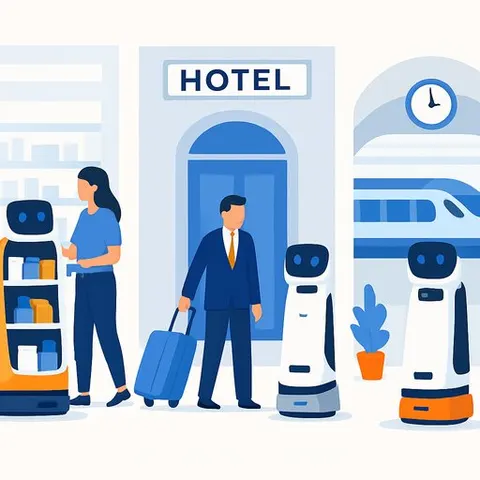
At the Davos Tech Summit 2026, Pudu Robotics deployed four autonomous robots across a hotel, supermarket, and train station plaza, providing live demonstrations of how embodied AI handles cleaning, delivery, and guest interaction in real-world conditions. For hospitality and events professionals, the deployment signals that commercial service robots are moving beyond proof-of-concept into practical, revenue-generating roles.
Two robots coordinate hotel service at Hilton Davos
Inside Hilton Davos, FlashBot Max and BellaBot Pro worked together to support back-of-house logistics and front-of-house guest services. FlashBot Max delivered supplies between floors by automatically calling and riding the hotel's elevators, while BellaBot Pro welcomed guests and carried food orders through autonomous navigation and multimodal interactions. The two robots handled processes that required real-time coordination - from order pickup and elevator integration to guest-facing communication - adapting as conditions changed throughout their shifts.
Cleaning robots prove themselves in retail and outdoor settings
At a SPAR supermarket, the PUDU CC1 Pro cleaned floors during normal business hours, navigating around customers and shelves using vision, LiDAR, and AI perception. Its rear camera detected leftover stains and automatically re-cleaned those areas, verifying task completion rather than just following a preset path. Meanwhile, the PUDU MT1 Max handled outdoor cleaning at Davos train station plaza, safely steering through crowds with 3D perception and multi-sensor fusion while its IP54 rating and rain avoidance kept it operational in changeable weather.
A single intelligence stack powers varied robots
Pudu Robotics built a unified embodied AI architecture around its PuduFM foundation model and PuduAgent platform. This shared brain lets robots of different categories - delivery, cleaning, industrial, and general-purpose - perceive environments, execute tasks, and collaborate using the same cognitive framework. Instead of building separate intelligence for each robot type, the company reduced deployment complexity and improved fleet coordination, which speeds up scaling across international markets.
Why this matters for hospitality and events professionals
The Hilton deployment shows that autonomous robots can now handle inter-floor delivery and guest-facing interaction simultaneously in a live hotel environment, not just a controlled demo. With over 130,000 robots already shipped globally and growing partnerships - such as the 200-unit cleaning robot order from Swiss retailer Denner - hotel chains, convention centers, and event venues have a growing body of field data to assess these systems for their own operations. Resources that track AI for Hospitality & Events can help teams evaluate what's deployable today, from room service runners to cleaning and concierge bots.