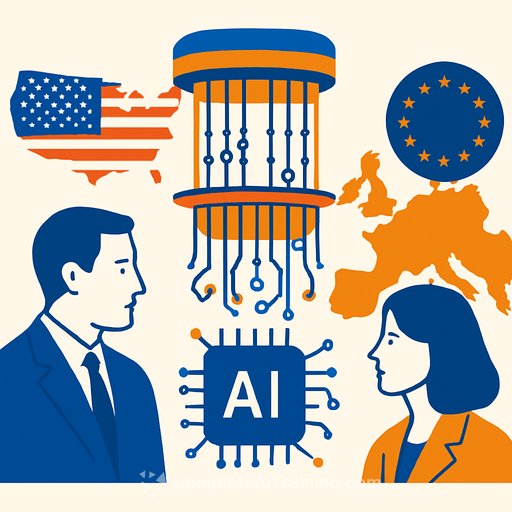
Europe is betting that quantum computing can help it leapfrog the United States in the artificial intelligence race. The European Union and individual nations have committed billions of euros to quantum research through coordinated public investment programs, aiming to convert scientific expertise into commercial AI leadership before fault-tolerant quantum computers become a practical reality.
Quantum computing processes information using qubits that can exist in multiple states simultaneously, unlike classical binary bits restricted to 0 or 1. This allows quantum systems to perform certain calculations exponentially faster than conventional computers. As AI models demand ever more computational power for training and inference, quantum approaches could deliver advantages in optimization, machine learning, and data analysis that reshape competitive dynamics.
Europe's research foundation
The EU's Quantum Flagship program supports research institutions, startups, and industrial partnerships across the continent. Germany, France, and the Netherlands have also launched national quantum strategies. European universities and laboratories have produced influential breakthroughs in quantum physics and information science, creating a research ecosystem that could translate into commercial advantage if connected effectively to AI development.
This strong academic base matters because the quantum field remains relatively young. Unlike the traditional AI race, where scale and access to massive datasets favor large American technology firms, quantum computing offers challengers an opportunity to compete on more equal footing. The Research strategies that worked for foundational science may now apply to building next-generation AI systems.
Where quantum meets AI
Quantum-enhanced machine learning algorithms could improve training efficiency, enabling AI systems to process vast datasets more effectively. Complex optimization problems in logistics, finance, pharmaceuticals, and energy could be solved in ways currently impractical using classical computers. If European companies commercialize these capabilities ahead of global competitors, they may create AI ecosystems that challenge existing market leaders.
American firms are not standing still. IBM, Google, Microsoft, and emerging startups continue to invest aggressively in both AI and quantum computing. Practical, fault-tolerant quantum computers capable of delivering widespread commercial benefits remain years away, meaning the window for European leadership depends on sustained investment and execution during this pre-commercial phase.
The commercialization gap
Europe has historically excelled in research but struggled to convert scientific discoveries into globally dominant technology companies. To translate quantum innovations into scalable businesses, European policymakers and investors must strengthen venture capital ecosystems, deepen industry collaboration, and design regulatory frameworks that encourage innovation while maintaining trust and security.
The intersection of AI and quantum computing remains particularly promising for AI for Science & Research applications. Drug discovery, materials science, and climate modeling all stand to benefit from quantum-accelerated computation, areas where European scientific institutions already hold deep expertise.
Why this matters for science and research professionals
Quantum computing's trajectory will directly affect research careers across disciplines. Scientists who understand both AI and quantum principles will be positioned to lead projects that bridge these fields. The funding flowing into European quantum initiatives means new roles in academic labs, national research centers, and startups are emerging now, even before fault-tolerant hardware arrives. Building literacy in quantum algorithms and their potential applications to your domain is a concrete step that pays off regardless of which region ultimately leads the commercialization race.
Your membership also unlocks: