
AI news ·
Rahul Mishra, Masaba Gupta and Jayanti Reddy tell Pearl Academy students that craft, business skills and AI fluency will define creative careers
Three top Indian designers told Pearl Academy students AI won't replace creative professionals-but will replace those who ignore it. Originality, craft, business skills, and technical fluency are all required now.
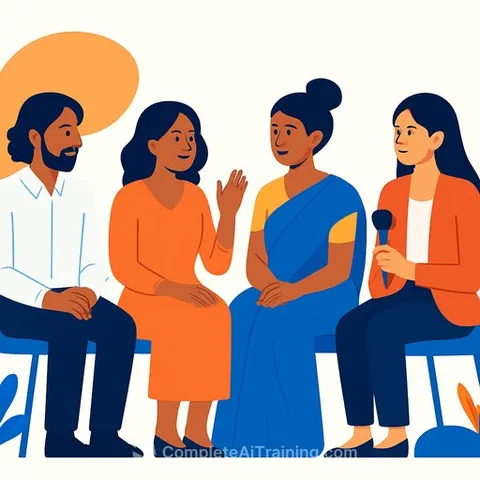
Three Indian Designers on Why AI Won't Replace You-But It Might Replace Your Competition
Three of India's leading designers delivered the same message to students at Pearl Academy this month: the future belongs to creatives who combine originality, craftsmanship, business acumen and technical fluency. Without all four, you're vulnerable.
Rahul Mishra, who designs haute couture for the Paris fashion calendar, Masaba Gupta, founder of House of Masaba, and Jayanti Reddy, who built a luxury bridal business from one tailor to hundreds of artisans, spoke at Pearl Academy's Global Icons Series. Their consensus was clear: AI is a tool, not a threat-but only if you know how to use it.
AI as a Collaborator, Not a Replacement
Mishra framed AI as faster research and wider perspective. "We never design alone. AI is simply another assistant. But the physical making, the craftsmanship, the human hand, that remains irreplaceable," he said.
His advice: use AI to accelerate research and test originality. Invest deeper in skills machines cannot replicate.
Gupta took a sharper angle. "AI will not replace you. It will replace the person who doesn't embrace AI," she said. Fear of AI, she argued, often reveals your real problem: unclear thinking. "The question is no longer whether something can be done faster. The question is whether your thinking is sharp enough to make the most of it."
The Business Side Nobody Talks About
Reddy offered a different reality check. She spends 10 percent of her time creating and 90 percent running the business.
"Designers often prepare for the creative side but underestimate the importance of building systems, teams and sustainable businesses," she said. That gap between craft and business discipline is where many creative careers stall.
What Pearl Academy Is Actually Doing
Pearl Academy has embedded AI across more than one-third of its curriculum through a partnership with OpenAI. Students work with generative AI tools across disciplines, not just as a separate module.
The school frames this as a "Human Intelligence + Artificial Intelligence" philosophy. The goal is producing graduates who are Domain Ready, AI Ready, Life Ready and Future Ready.
Aditi Srivastava, president of Pearl Academy, said the Global Icons Series connects classroom learning to industry reality. "Some of the most meaningful learning comes from direct interactions with people who have built their craft through lived experience."
What This Means for Your Career
The three designers weren't optimistic because they're paid to be. They were optimistic because they've already adapted. Mishra uses AI in research. Gupta uses it to test ideas. Reddy uses it to manage operations. None of them stopped designing.
The pattern: creatives who treat AI as a tool-not a threat or a savior-are already pulling ahead. Those who ignore it are falling behind.
If you work in creative fields, the question isn't whether AI will affect your work. It already has. The question is whether you're sharper at thinking than the person next to you, whether you understand your craft deeply enough that no tool can replicate it, and whether you can build a sustainable business around what you make.
Want to develop those skills? Start with AI for Creatives or explore AI Design Courses that teach practical workflows, not theory.