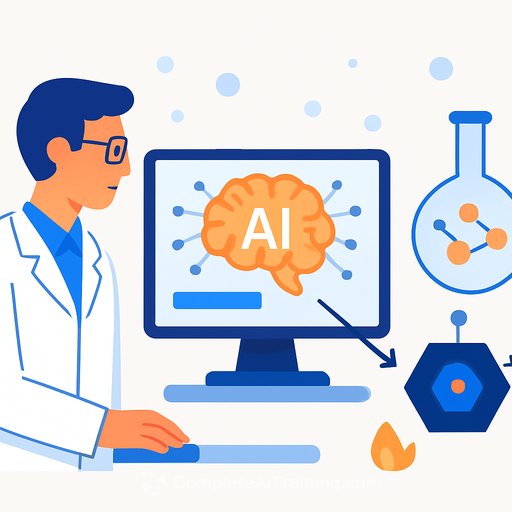
An international research team has built DigMethpy, an AI-powered platform designed to accelerate the search for catalysts that enable methane pyrolysis - a process that produces hydrogen without releasing carbon dioxide. The platform combines experimental data, machine learning models, and large language models into a single workflow that could cut the time and cost of discovering effective molten catalysts.
Hydrogen is widely seen as a clean fuel for future energy systems, but conventional production methods often emit CO₂ as a byproduct. Methane pyrolysis splits methane into hydrogen and solid carbon, sidestepping direct emissions. Its main bottleneck is identifying efficient methane pyrolysis catalysts. Because molten metals, alloys, and salts exist in a vast, poorly understood chemical space, researchers have typically relied on slow, trial-and-error experimentation.
DigMethpy addresses this by building a closed-loop system that continuously gathers data from scientific literature and experiments, predicts promising catalyst candidates, and refines its recommendations based on validation feedback. The platform's database now contains more than 40,000 curated data points pulled from over 500 publications and computational records covering a wide range of molten and mixed catalyst systems.
How the platform identifies promising catalysts
Using DigMethpy, the researchers pinpointed critical chemical properties tied to catalyst performance - atomic charge-related descriptors, diffusion behavior, and hydrogen adsorption characteristics. These insights then guided the design of highly active multicomponent molten alloy catalysts for methane pyrolysis.
A step toward autonomous discovery
"DigMethpy represents an important step toward data-driven and eventually autonomous catalyst discovery," said Hao Li, Distinguished Professor at Tohoku University's Advanced Institute for Materials Research (WPI-AIMR). "By connecting experimental knowledge, computational modeling, machine learning, and large language models in a unified workflow, we can accelerate the development of catalysts needed for cleaner hydrogen production and other sustainable energy technologies."
The study appeared in the journal AI Agents on 13 May 2026 (DOI: 10.20517/aiagent.2026.11). The research team plans to further enlarge the DigMethpy database, sharpen its predictive accuracy, and build more autonomous multi-agent systems for next-generation catalyst discovery.
Why this matters for scientists and researchers
DigMethpy shows how artificial intelligence can shorten the catalyst discovery pipeline by turning scattered experimental and computational results into actionable predictions. For materials researchers and catalytic chemists, the platform points to a growing need for AI fluency. Resources such as AI for Science & Research explore this shift, and training options like AI Research Courses help professionals build the skills to apply similar data-driven discovery methods in their own work.
Your membership also unlocks: