
AI news ·
Researchers propose ethical explainability metric to measure AI trustworthiness in healthcare
Accuracy alone doesn't make AI trustworthy in hospitals, researchers say. A new framework measures whether AI decisions are explainable and ethically sound enough for clinicians to act on.
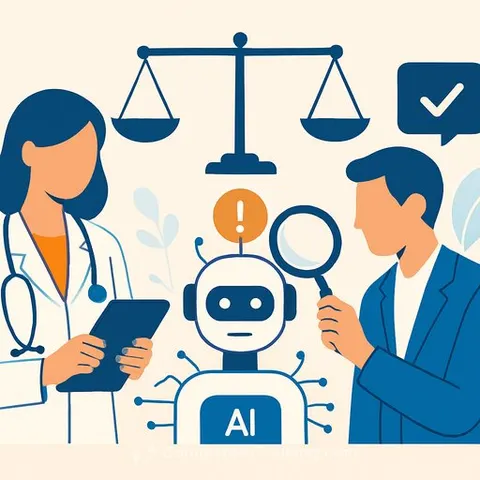
Healthcare AI needs trust metrics beyond accuracy, researchers say
Hospitals increasingly rely on AI to monitor patients and detect cyber threats, but accuracy alone doesn't guarantee clinicians will trust these systems. Researchers have proposed a new framework to measure whether AI decisions are ethically sound and understandable to human experts.
The study, published in Information, introduces a metric called Ethical Explainability designed to evaluate how well AI aligns with human judgment while reducing uncertainty in high-stakes environments. Current evaluation methods focus on performance metrics like accuracy, missing whether a system's reasoning is transparent or ethically acceptable.
The gap between correct answers and trustworthy explanations
In connected healthcare systems-networks of medical devices, monitors, and diagnostic tools-a correct AI output means little if clinicians can't understand how the system reached that conclusion. This matters especially when errors can harm patients.
The framework combines two components: the Human Agreement Ratio and the Entropy Reduction Index. The first measures whether AI decisions match expert judgment and whether clinicians find the explanations acceptable. The second quantifies how much an explanation reduces uncertainty in human decision-making, using information theory to measure shifts in expert confidence.
Together, these create a single score reflecting trustworthiness-a more complete picture than traditional performance metrics alone.
Real risks in connected healthcare systems
Healthcare networks face growing cybersecurity threats. Ransomware attacks and device vulnerabilities are becoming more frequent and sophisticated. AI integration introduces additional problems: biased decisions, opaque reasoning, and unclear accountability when things go wrong.
Many AI models, particularly deep learning systems, produce accurate predictions but can't explain their logic in ways clinicians understand. This creates a paradox-clinicians may over-rely on systems they don't fully trust, or under-trust systems that could help them.
Not all explanations are useful. An explanation can be technically accurate but ethically unacceptable if it's misleading, overly complex, or exposes patient information. The researchers identified five ethical domains that must be evaluated: fairness, transparency, confidentiality, accountability, and patient-centered design.
Putting the metric to work
In practice, the metric can score AI-driven intrusion detection systems that flag unusual activity in healthcare networks. High-scoring alerts-those with strong expert alignment and significant uncertainty reduction-could trigger semi-automated responses like device isolation. Low-scoring alerts would require manual review to prevent errors.
This approach creates an audit trail for AI decisions, supporting regulatory compliance and post-incident analysis. For clinical applications like remote patient monitoring, the metric ensures AI supports rather than replaces clinician judgment by providing explanations that are both accurate and understandable.
The framework also enables fairness audits, helping institutions identify whether AI performs differently across patient groups or device types.
Challenges ahead
The researchers acknowledge the framework is early-stage and needs real-world validation using actual datasets, multiple AI models, and different explanation techniques. One practical challenge: evaluating explanations relies heavily on expert input, which is difficult to scale in fast-moving healthcare environments.
The authors suggest sampling-based audits and automated proxies to reduce the burden on human evaluators while preserving metric integrity.
As digital health systems evolve, measuring and managing trust will become increasingly important for both system performance and patient safety. In environments where AI recommendations can affect treatment decisions, success depends not just on accurate predictions, but on explanations that clinicians can understand and ethically accept.
Learn more about AI for Healthcare applications and AI Research Courses for deeper understanding of validation methodologies.