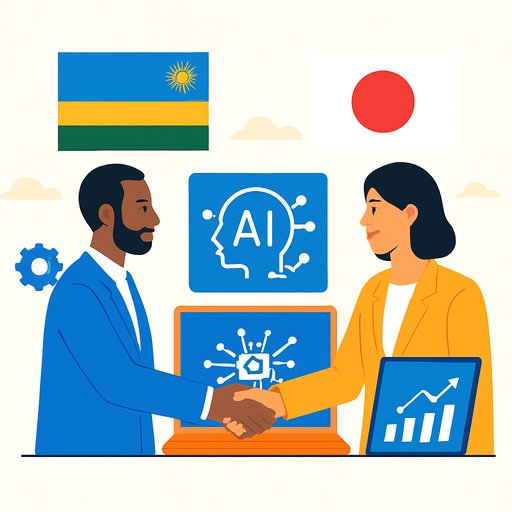
Rwanda-Japan Talks Put Human Capital and AI Collaboration Front and Center
Rwanda's Ministry of ICT and Innovation met with Japan's newly appointed Ambassador to Rwanda to deepen cooperation on skills development, data-driven innovation, and applied AI. Minister Paula Musoni and His Excellency Nakajo Kazuya reviewed current partnerships and explored new avenues to support Rwanda's digital transformation.
For HR leaders, the headline is clear: talent supply must keep pace with national tech goals. These talks signal fresh opportunities for capability building, cross-border training, and shared standards that reduce skills gaps and speed up adoption inside organizations.
Learn more about the Ministry's mission and programs via the Rwanda Ministry of ICT and Innovation.
Key areas of cooperation discussed
- Skills development at scale: Technical upskilling in data, AI, and software, paired with practical pathways into employment.
- Data-driven innovation: Joint initiatives that apply analytics and AI to public services and industry productivity.
- Responsible AI: Attention to governance, security, and ethical use to protect citizens and organizations.
- Talent exchange: Internships, research placements, and short-term expert visits to transfer know-how quickly.
- Curriculum and instructor support: Co-developed programs, teaching resources, and train-the-trainer efforts.
What HR teams can do now
- Run a skills inventory: Map current roles to future skills in data literacy, AI tooling, and digital operations. Prioritize gaps tied to 12-18 month roadmaps.
- Pilot AI in L&D: Use adaptive learning, skill assessments, and AI coaching to shorten time-to-competence.
- Build early-career pipelines: Partner with universities and bootcamps for apprenticeships and job-ready projects aligned to business needs.
- Stand up AI governance for HR: Define policies for data use, model validation, and bias checks across recruitment, mobility, and performance.
- Measure outcomes: Track skill acquisition, internal mobility, and productivity lift. Tie funding to metrics, not activity.
Why this matters for HR leadership
National partnerships like this reduce friction: clearer standards, shared training assets, and faster access to specialized talent. They also give HR a credible route to scale reskilling while keeping ethics and compliance in view.
As Rwanda and Japan coordinate on human capital and AI, organizations that prepare now will hire faster, upskill cheaper, and execute digital projects with less risk.
Helpful resources for HR
- AI for Human Resources - use cases and tools for recruiting, talent management, and workforce analytics.
- AI Learning Path for Training & Development Managers - practical curricula to build scalable upskilling programs.
Your membership also unlocks: