
AI news ·
SaaS ERP market projected to reach $281.58 billion by 2034 as AI becomes baseline expectation
The global SaaS ERP market is projected to reach $281.58 billion by 2034, growing at 13% annually. AI is now a baseline buyer expectation, and SMEs drive 60% of market growth.
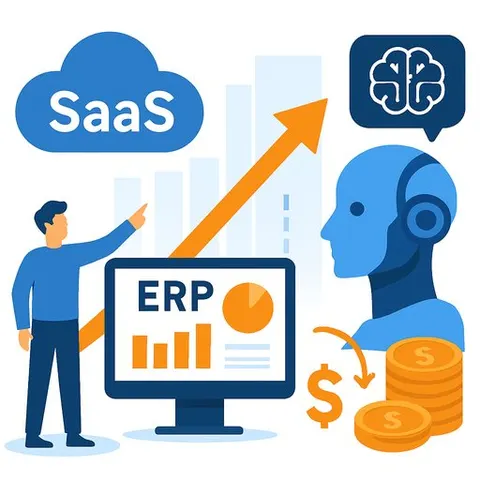
SaaS ERP Market Accelerates as AI and Cloud Reshape Enterprise Operations
The global SaaS-based ERP market is entering a period of accelerated growth. Cloud adoption, AI integration, and the decisive shift away from on-premise infrastructure are driving this expansion. For operations leaders, the trajectory is reshaping procurement decisions, integration strategies, and competitive positioning.
The global ERP software market is projected to reach $281.58 billion by 2034, expanding at a 13% compound annual growth rate. Cloud-native SaaS platforms are the primary driver, with the cloud ERP segment expected to reach $138.56 billion by 2031 at a 19.65% CAGR.
AI Is Now a Baseline Expectation, Not an Add-On
AI and automation have become essential capabilities in ERP systems. Enterprise buyers now expect embedded intelligence and real-time automation as standard features rather than optional add-ons. Vendors treating AI as a configurable layer rather than a core platform capability will face displacement as procurement strategies evolve.
Finance management leads ERP adoption, capturing approximately 35% of total SaaS ERP market share. Organizations demand real-time financial insights, regulatory compliance, and automated reconciliation. Supply chain and logistics applications are the fastest-growing segment, with a projected CAGR of 16% through 2028, driven by supply chain volatility, e-commerce expansion, and the need for end-to-end visibility.
When evaluating platforms, assess AI functionality as a core architectural element, not a feature layer. Platforms embedding AI natively in financial workflows, demand forecasting, and compliance monitoring deliver materially different outcomes than those applying AI as a surface-level add-on. The ERP market is evolving from a back-office system into a strategic backbone that supports real-time, data-driven decisions across every business function.
Operations leaders should explore AI Agents & Automation resources to understand how these capabilities integrate into modern ERP workflows.
SMEs Drive 60% of Market Growth
Small and mid-sized businesses account for approximately 60% of global SaaS ERP market share. This dominance stems from the affordability, modularity, and rapid deployment characteristics of subscription-based cloud platforms, which appeal to organizations without large IT infrastructure budgets.
The fastest-growing sub-segment within the SMB category carries a projected 14% CAGR from 2023 to 2028. This growth is accelerating demand for vertical-specific ERP modules in manufacturing, retail, and healthcare-sectors where industry-specific compliance and operational requirements make horizontal platforms insufficient.
Low-code and no-code customization capabilities are emerging as a key differentiator. Mid-market organizations can now configure workflows without large implementation budgets or dedicated developer resources. For implementation partners and vendors, the SME expansion signals a clear priority toward modular, industry-tailored solutions that deploy rapidly and scale incrementally.
Asia-Pacific Is the Fastest-Growing Region
North America remains the dominant region, generating 34 to 40% of global ERP revenue, backed by mature cloud infrastructure and a deep partner ecosystem. Asia-Pacific is emerging as the fastest-growing region, with a 27.10% CAGR driven by government digitalization programs, rising manufacturing investment, and economic development across Southeast Asia and China.
This geographic shift carries direct implications for enterprise architects managing multinational ERP strategies. Platforms with strong regional data sovereignty controls, low-latency cloud infrastructure, and localized compliance support will have a structural advantage as Asia-Pacific adoption accelerates. Partnerships between ERP vendors and hyperscale cloud providers are increasingly a prerequisite for competitive market access in those regions.
For operations teams, AI Learning Path for Operations Managers covers practical applications of AI in supply chain optimization and workflow automation-core competencies in the evolving ERP market.
What Operations Leaders Should Evaluate
When assessing SaaS ERP investments, focus on these dimensions:
- Integration depth with existing financial and supply chain systems
- Native AI and automation capabilities built into core workflows
- Multi-jurisdiction compliance support for global operations
- Vendor ecosystem strength and implementation partner availability
- Credible roadmap for vertical-specific module development
These criteria separate viable long-term platforms from legacy systems in a subscription-model wrapper. As the market shifts toward cloud-native architectures and AI-driven operations, procurement decisions made today will determine competitive positioning for the next decade.