
AI news ·
U.S. military tests AI battlefield systems at Africa exercise, including tools to speed up kill chain
The U.S. Army tested AI targeting systems in Morocco that cut decision time from hours to three minutes. Soldiers also replaced 40 troops with two armed robots in breach drills, raising debate over how much authority machines should hold.
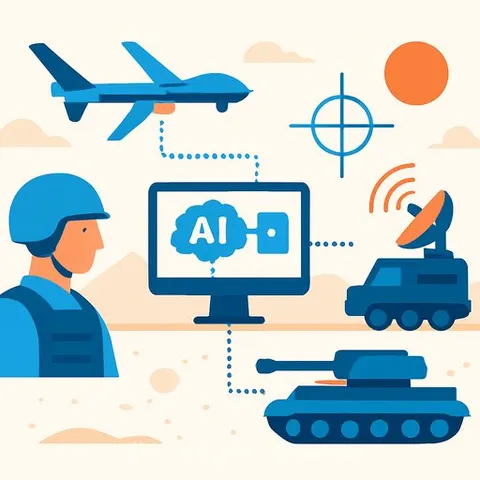
U.S. Military Tests AI Systems to Speed Up Combat Decisions in Morocco Exercise
The U.S. Army used African Lion 2026, a multinational military exercise in southern Morocco, to test artificial intelligence systems designed to compress battlefield decision-making from hours to minutes. The exercise involved 30 partner nations and showcased how AI platforms can process massive quantities of combat data and help commanders identify targets faster than traditional methods.
Lt. Col. Ramon Leonguerrero told reporters that personnel operating from a Joint Operations Center in Agadir used an AI platform built by defense contractor Palantir to make targeting decisions in three minutes - a process that would have taken two to three hours five years ago.
The Kill Chain Gets Shorter
Military strategists call the sequence from target identification to firing a weapon the "kill chain." Shortening this chain was a central focus of the exercise, with AI handling data analysis while humans retained final approval authority over strikes.
Leonguerrero acknowledged that fully autonomous systems capable of making lethal decisions without human approval already exist. He declined to specify whether any real-world operations have deployed such systems.
The Palantir platform relies on Anthropic's Claude large language model to help operators query battlefield intelligence in plain English. This partnership persists despite recent friction between the Trump administration and Anthropic, which has publicly opposed using Claude for mass surveillance or autonomous weapons.
Robots Replace Soldiers in High-Risk Operations
A second application on display involved removing soldiers from dangerous situations entirely. Seattle-based Overland AI demonstrated its ULTRA autonomous vehicle - a five-foot-tall robot equipped with a machine gun, mines, and explosives that a remote operator controls via laptop.
1st Lt. Vincent Gasparri, who leads the 173rd Airborne Brigade's innovation team, said breaching operations are among the military's most dangerous tasks. In one exercise, his unit replaced approximately 40 soldiers with two robots.
"You don't have to worry as much about protection and survivability," Gasparri said. "You can move faster and protect your soldiers while you do it."
Caution About Removing Humans From Decisions
Not all military personnel embrace full automation. One soldier told reporters he would never delegate critical decisions to a computer, calling AI a force multiplier rather than a replacement for human judgment.
Gen. Dagvin R.M. Anderson, who oversees U.S. Africa Command, called the notion of machines making lethal decisions "ghoulish" and "disturbing." But he also warned against avoiding the technology entirely.
"If you choose not to adopt it, we will be at a disadvantage," Anderson said. "Our adversaries will adopt it. I would not be willing to put our nation into that position."
Defense Secretary Pete Hegseth told the Senate Armed Services Committee in April that AI would not make lethal decisions, though he stopped short of committing to that policy permanently.
What Operations Teams Should Know
For professionals managing military or enterprise operations, the African Lion exercise reveals how organizations are already compressing decision cycles through AI. The tension between speed and human oversight - visible in the Moroccan drills - will define how these systems get deployed.
Understanding both AI for Operations and AI Agents & Automation is increasingly essential for operations leaders who will need to evaluate these systems, manage their integration, and maintain accountability when machines assist in high-stakes decisions.