
AI news ·
Salesforce unveils AIforce at Dreamforce as Benioff touts AI strategy
Salesforce CEO Marc Benioff unveiled AIforce at Dreamforce, a new layer connecting company data and workflows directly to Anthropic's Claude. The move comes ahead of a Wednesday investor day expected to set financial targets for the company's AI revenue trajectory.
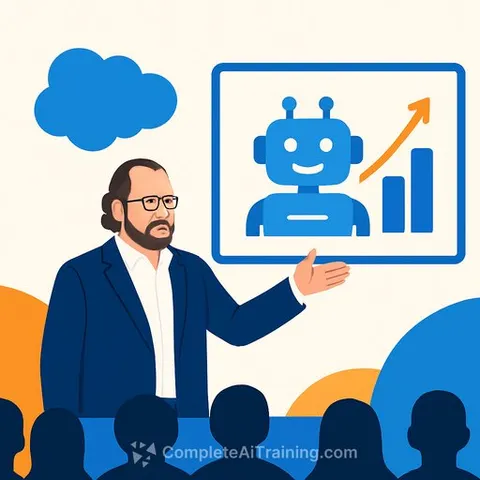
Salesforce CEO Marc Benioff used his Dreamforce keynote Tuesday to unveil AIforce, a new software interface layer that connects the company's data, workflows, and AI agents directly into Anthropic's Claude. The announcement signals a deepening integration strategy as the enterprise software giant positions its AI stack for the next fiscal year. An investor day focused on financial targets for Salesforce stock is scheduled for Wednesday.
The AIforce integration
AIforce functions as a connective layer rather than a standalone product. It routes Salesforce's proprietary data and workflow automation into Anthropic's large language model, Claude. The architecture aims to let enterprise customers run AI agents on their own Salesforce data without building custom integrations from scratch.
Salesforce has invested in Anthropic, the AI safety-focused startup behind Claude, across multiple funding rounds. The AIforce announcement formalizes that relationship at the product level. It also puts direct pressure on competitors like Microsoft, which has built its own Copilot stack atop OpenAI's models.
Dreamforce timing and investor stakes
The keynote launched Salesforce's annual customer conference at a moment when the company faces questions about AI monetization. Wall Street analysts have pressed Benioff on when AI products will materially shift the company's revenue trajectory. The Wednesday investor day is expected to provide financial targets that address those questions directly.
For executives tracking the enterprise AI market, the AIforce move follows a familiar pattern: platform companies are racing to embed generative AI into existing workflows rather than selling it as a separate line item. The bet is that tighter integration drives stickier subscriptions and higher per-seat pricing over time.
Why this matters for executives and strategy
Benioff's announcement underscores a shift in how major SaaS vendors package AI. Rather than selling a discrete AI assistant, Salesforce is embedding the capability into the data layer itself. For leaders evaluating their own AI strategy, the takeaway is clear: the market is moving toward AI that operates on proprietary company data, not generic public models. Vendors that control both the data platform and the AI interface layer - as Salesforce now claims to with AIforce - will push that as a competitive moat in enterprise sales cycles. The Wednesday investor session will reveal whether the company can attach hard numbers to that story.