Salesforce's 2025 Shake-Up: What It Means for Customer Support
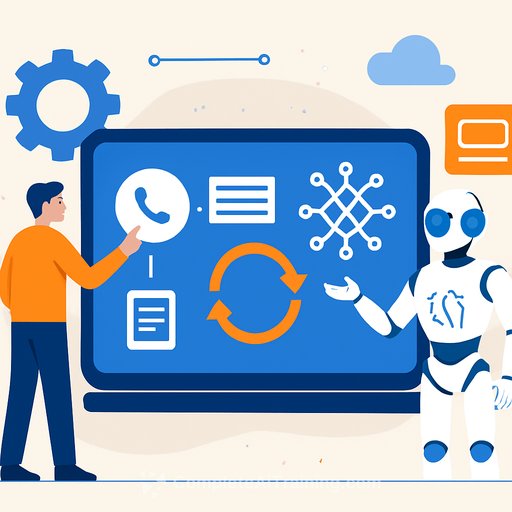
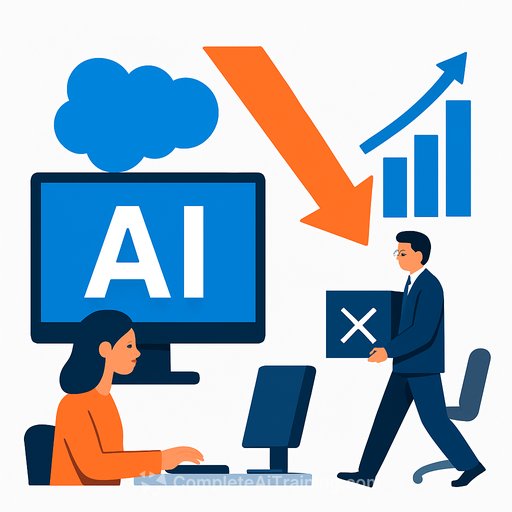
Salesforce cut thousands of customer support roles in 2025 as its AI agents took over a large share of incoming queries. Reports indicate more than 4,000 support positions were removed while hiring is ramping up in sales.
Marc Benioff has said AI agents now handle up to 50% of customer questions. It's a clear signal: routine support work is getting automated, and headcount is being reshuffled toward revenue-facing roles.
Why This Matters If You Work in Support
- AI is taking the repetitive, high-volume tickets first: password resets, billing status, simple how-tos.
- Human work shifts to exceptions: complex troubleshooting, empathy-heavy conversations, and high-value accounts.
- Quality still matters: bots can be fast but wrong. Companies will judge teams on accuracy, not just speed.
- Restructuring is widespread in tech, with 2025 cuts climbing across big names, citing AI efficiency and cost pressure.
Where The Jobs Are Moving
Salesforce is expanding sales teams while slimming support. That doesn't mean support expertise is obsolete-it's being repurposed.
- AI Support Analyst: monitors bot performance, fixes conversation flows, reduces error rates.
- Conversation Designer: writes prompts, intents, fallbacks, and edge-case logic.
- Knowledge Manager: builds structured knowledge for bots and humans, maintains articles, audits drift.
- Escalation Engineer: owns the handoff between bot and human, resolves complex issues, feeds learnings back to the system.
- AI QA and Compliance: reviews interactions for accuracy, bias, safety, and policy alignment.
- Customer Success for AI Products: aligns automation with account goals and renewals.
90-Day Action Plan To Stay Valuable
Days 0-30: Get Your Baseline
- Map your top 50 intents by volume, CSAT, and resolution accuracy.
- Measure current containment rate, average handle time (human vs. bot), and deflection quality.
- Identify 10 repeat tickets you can automate safely with guardrails.
Days 31-60: Build Small, Prove Fast
- Ship 3-5 automations: one high-volume intent, one complex flow with fallback, one proactive notification.
- Create a clean knowledge base structure: canonical answers, versioning, ownership, and review cadence.
- Set up observability: transcripts sampling, false-positive/negative tracking, and weekly error triage.
Days 61-90: Scale What Works
- Expand to 20-30% of total intent volume with strict escalation rules.
- Run A/B on bot vs. human answers for accuracy and CSAT; keep what beats your human baseline.
- Publish a monthly impact report: tickets avoided, minutes saved, cost per resolution, and quality trends.
Core Skills For AI-Heavy Support
- Prompt and intent design: clear intents, context windows, smart fallbacks, and safe refusals.
- Knowledge curation: structured content, source-of-truth discipline, and change control.
- Bot operations: monitoring, red-teaming, incident playbooks, and fast rollbacks.
- Data literacy: read dashboards, spot drift, segment by intent, channel, and customer tier.
- Human escalation: empathy, negotiation, and root-cause analysis when the bot fails.
Metrics That Prove Your Impact
- Resolution accuracy (bot vs. human) and error rate by intent.
- CSAT delta: bot-only, human-only, and blended journeys.
- Containment rate with quality gates (no forced loops).
- Average handle time including bot+human handoffs.
- Cost per resolution and time-to-first-response across channels.
- Escalation hygiene: clear ownership, no dead-ends, fast time-to-human.
Resume And Interview Pivots
- Lead with outcomes: "Reduced ticket volume 28% via three automations while improving CSAT by 1.9 points."
- Show your system: intent map, guardrails, review cadence, and rollback procedures.
- Quantify knowledge work: "Consolidated 600 articles into 220 canonical entries; cut answer search time by 40%."
- Prove safety and quality: "Implemented transcript sampling and bias checks; dropped bot error rate from 12% to 3%."
Risks You Need To Manage
- Service quality drift: bots confidently wrong without fresh knowledge and audits.
- Privacy and data leakage: strict access controls, PII redaction, and retention policies.
- Escalation gaps: customers stuck in loops without clear human handoff.
- Vendor lock-in: exportable knowledge and documented flows to keep options open.
- Morale dips during headcount shifts: communicate metrics, wins, and career paths.
Context And Useful Links
Salesforce is leaning hard into AI agents across its platform, which explains the shift in staffing priorities. You can read more about their AI direction on the official site here: Salesforce AI.
If you want to upskill for AI-heavy support roles, explore practical training and certifications here: Courses by job and Popular certifications.
Bottom Line
Automation is taking the repetitive work. The opportunity is in building, supervising, and improving the systems that now touch most customer conversations.
Shift your focus to measurable outcomes, safety, and accuracy. That's how support pros stay essential in an AI-first operation.
Your membership also unlocks: