
AI news ·
Samsung and SK Hynix semiconductor clusters drive housing demand and urban growth across South Korea
Samsung broke ground on its fifth Pyeongtaek semiconductor factory March 5, 2026, part of a multi-trillion-won industrial push reshaping housing demand across eight South Korean regions through 2030.
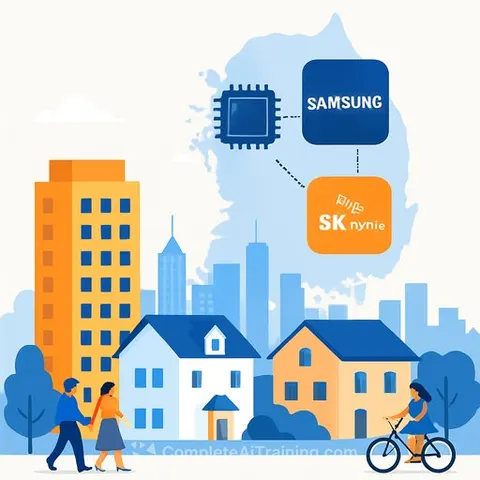
South Korea's Real Estate Market Tracks Semiconductor and AI Expansion
Samsung Electronics broke ground on its fifth semiconductor factory at Pyeongtaek on March 5, 2026, marking a visible shift in South Korea's real estate market. The facility represents one piece of a much larger industrial reorganization driven by the country's push into AI and semiconductor manufacturing.
Major conglomerates have committed hundreds of trillions of Korean won through 2030 to build semiconductor clusters across eight regions: Yongin, Seoul, Pangyo, Pyeongtaek, Giheung, Hwaseong, Icheon, and Cheongju. These investments are reshaping housing demand and property values in surrounding areas.
Data Centers Drive Coastal Development
The AI infrastructure boom extends beyond chip fabrication. SK Group and Amazon Web Services are investing 7 trillion won in an AI data center at the Ulsan Mipo National Industrial Complex, scheduled to open in 2027. OpenAI is leading a separate 2 trillion won data center project in Pohang's Gwangmyeong Industrial Complex.
These facilities require massive power and cooling capacity but create fewer direct jobs than traditional factories. Real estate value in these areas depends on whether other AI-related companies establish operations nearby.
Emerging Regional Hubs
Saemangeum in Jeonbuk is emerging as a second-tier development site. Hyundai Motor Group is building a 1.1 million square-meter complex for AI, robotics, and hydrogen energy. Vice Chairman Jang Jae-hoon outlined the vision at a February 27, 2026 event, signaling potential property appreciation in nearby cities like Gunsan and Gimje.
Changwon City in Gyeongnam is attracting defense and energy firms integrating AI operations. Busan's Centum2 district is positioning itself as a regional tech hub, while Yongin's semiconductor cluster benefits from Korea Electric Power Corporation's new integrated power substation.
Political Debate Over Industrial Concentration
Relocation debates that intensified in late 2025 have cooled as of May 10, 2026. The government is committed to developing the Yongin semiconductor cluster, with Samsung Electronics and SK Hynix anchoring a national advanced strategic industry framework.
Semiconductor production requires coordination across facilities, materials suppliers, equipment vendors, research talent, and power grids. This complexity makes large-scale relocation impractical in the near term.
Politicians in Jeonbuk continue pushing for industrial decentralization as part of balanced national development efforts. June 3, 2026 local elections could revive relocation discussions, though hundreds of trillions of won already committed to current infrastructure projects makes major shifts unlikely.
Housing Market Responds to Industrial Growth
Yongin's Cheoin-gu district is experiencing measurable residential demand. New complexes like "Prugio One Cluster" and "Dunjeon Station Epit" are achieving high contract rates, signaling buyer confidence in the area's economic future.
Developers are using digital marketing strategies to accelerate sales. AI for Marketing tools enable 360° drone tours showing proximity to the semiconductor hub-typically highlighting a maximum 10-minute commute as a primary selling point.
Virtual 3D tours of planned parks and community spaces let buyers experience developments before construction finishes. This reduces friction in the purchase decision, particularly for families relocating from other regions who cannot visit sites in person.
The "One Paper" solution bundles key property information into a smartphone-accessible link, making it easier for family members to review and approve decisions together. These approaches are converting browsing into contracts.
Demographics and Job Creation
South Korea's 50- and 60-year-olds own the country's most valuable properties. As AI extends working lives, their continued economic activity supports housing prices. This demographic stability provides a floor under the market.
Advanced manufacturing and R&D operations-sometimes called "physical AI"-are expected to draw young talent to regions with strong industrial and educational infrastructure. This creates demand cycles that benefit residential real estate.
Jobs requiring creative intelligence, social skills, or fine manual work remain harder for AI to replace. City-center properties favored by artists, caregivers, and skilled tradespeople may offer distinct investment opportunities separate from tech-driven appreciation.
Risks and Constraints
The sector faces bottlenecks in data availability, electrical power, and semiconductor supply itself. These constraints mirror the Gold Rush dynamic, where suppliers of critical resources often outperform direct operators.
Demand for centralized data centers could shift. Power supply imbalances may emerge. Changes in AI scaling laws could alter investment priorities. Any of these shifts could cool the market as quickly as it has heated.
For AI for Real Estate & Construction professionals, the current environment demands attention to infrastructure capacity, regional policy shifts, and the durability of industrial clusters beyond initial investment announcements.