
AI news ·
Samsung ends home appliance sales in China as it shifts focus to semiconductors
Samsung will stop selling home appliances in mainland China, retreating from a market where local rivals cut its share to near zero. The company's focus is shifting to semiconductors, where Q1 2026 profit topped its entire 2025 earnings.
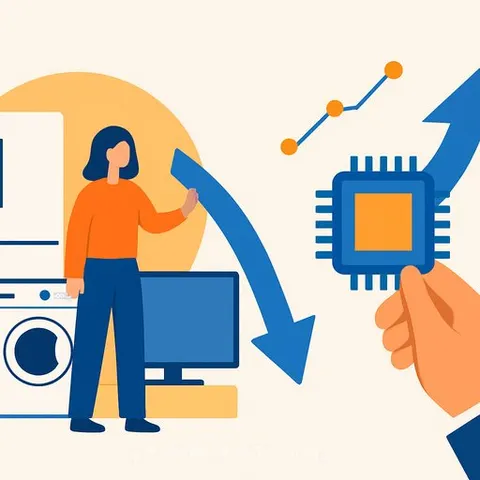
Samsung exits China's home appliance market as semiconductor profits soar
Samsung Electronics said Wednesday it will stop selling home appliances in mainland China, marking a significant retreat from a consumer market where domestic rivals have steadily eroded its position. The company will discontinue televisions, air conditioners, refrigerators, washing machines, and other household products, though it will continue after-sales service.
Smartphones will remain available in China, though Samsung's presence there has already shrunk dramatically. The company's phone market share fell from nearly 20 percent in the early 2010s to less than 1 percent today, according to IDC data.
The exit reflects a deliberate corporate choice. Samsung's earnings have surged as demand for semiconductors accelerates alongside the artificial intelligence boom. First-quarter 2026 revenue reached 133.87 trillion won ($92.3 billion), with operating profit of 57.23 trillion won-exceeding the company's entire earnings for 2025.
Samsung's stock price in Seoul has climbed 107 percent this year, with the company's market value hitting a record 1,710.8 trillion won on Wednesday.
Why this matters for sales professionals
Samsung's move illustrates how market dominance in one sector doesn't guarantee success everywhere. Chinese appliance makers-typically lower-cost and increasingly sophisticated-outcompeted Samsung in a market where price and local preferences matter.
The company's decision to concentrate resources on semiconductors shows how businesses reallocate sales efforts when profit margins differ dramatically. Memory products tied to AI infrastructure generate far higher returns than consumer appliances in a crowded market.
For sales teams, the lesson is straightforward: defending declining positions in mature markets often costs more than redirecting effort toward growing segments. Samsung's choice to exit rather than fight reflects that reality.
Learn more about how business strategy shapes sales priorities with AI for Executives & Strategy or explore how sales teams adapt to market shifts with AI for Sales.