
AI news ·
SAP and Google Cloud expand partnership to connect enterprise data with multi-agent AI for marketing
SAP and Google Cloud are connecting enterprise data with multi-agent AI to give support teams a single view of customer history, orders, and inventory. The goal: agents stop asking customers to repeat themselves.
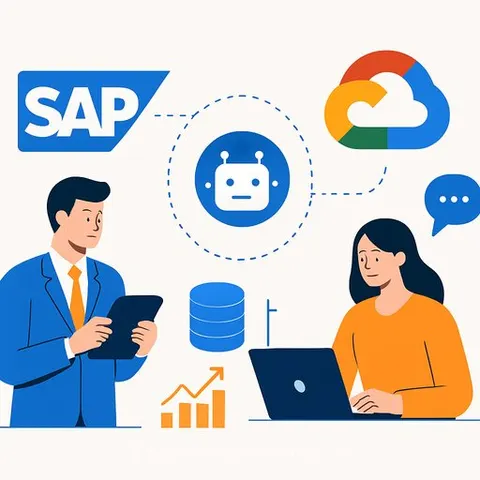
SAP and Google Cloud tackle the customer support disconnect
Customer support teams face a persistent problem: the company knows fragmented pieces of customer history, but no one piece talks to another. A support agent sees transaction data. Marketing sees engagement history. Operations sees inventory status. The customer sees a company that doesn't know them.
That friction is about to get worse. AI agents can now act faster than the systems supporting them. When those agents work from incomplete or outdated data, they amplify the problem rather than solve it.
SAP and Google Cloud are addressing this head-on by connecting enterprise data with multi-agent AI coordination. The partnership links SAP's operational and customer data with Google Cloud's real-time signals and AI capabilities, creating a unified view that support teams-and the AI agents assisting them-can actually use.
The data problem is the real bottleneck
Research from SAP shows that more than half of marketers say fragmented data prevents them from acting in the moment. Support teams face the same issue. Insights arrive late. Context is missing. Manual work stitches together information that should already be connected.
The result shows up in customer frustration. Forty-five percent of customers say brands can't keep up with their expectations. Forty-four percent say interactions feel less personal than before. Support teams absorb this complaint directly.
Only 46% of brands can connect their data in a way that powers AI sustainably. The gap between AI capability and data readiness is where most organizations fail.
How the partnership works
SAP Business Data Cloud connects customer and operational data-orders, inventory, fulfillment status, interaction history-with semantic meaning. Google BigQuery adds real-time signals like location and weather data. Together, they create shared context.
SAP Engagement Cloud executes on that context. It orchestrates interactions across channels and manages customer lifecycle workflows. Joule, SAP's AI assistant, coordinates tasks within those workflows. Gemini Enterprise, Google's AI hub, enables agents from both companies to exchange context and act together.
For support teams, this means an agent handling a customer issue has access to the full picture: recent purchases, service history, current offers, inventory status, and delivery timelines. No more asking customers to repeat information.
What changes for support operations
The multi-agent network reduces manual work. Support staff spend less time gathering information and more time solving problems. Agents can handle routine tasks-updating customer records, routing issues, generating initial responses-while humans focus on complex cases.
The system continuously improves based on what actually happens. When a customer reports an issue with a recent purchase, the system connects that signal to inventory data, delivery tracking, and similar customer cases. Patterns emerge faster.
Consistency improves. A customer receives the same information from support that they received in marketing communications. Offers match inventory. Promises align with fulfillment capability.
The broader picture
This isn't only about support. Customer experience spans sales, commerce, service, and operations. A customer service interaction shapes loyalty and lifetime value. A personalized offer depends on inventory and delivery capability. A brand promise made in marketing must be kept by operations.
The foundation is the same everywhere: trusted data, unified context, and direct connection to execution. Support teams benefit directly from that foundation, but the model extends across the entire customer-facing organization.
The business outcomes are measurable: faster response times, lower operational costs, higher consistency, and better customer retention. For support teams specifically, the outcome is simpler: customers don't have to repeat themselves, and agents have what they need to actually help.
Learn more about AI for Customer Support and how AI agents are reshaping support operations.