
AI news ·
Saudi developers use AI scheduling tools to cut construction delays on giga-projects
Saudi Arabia's real estate developers are moving AI into daily construction operations to meet Vision 2030's demanding project timelines. One JLL-managed development recovered up to 60 lost schedule days using AI simulation tools.
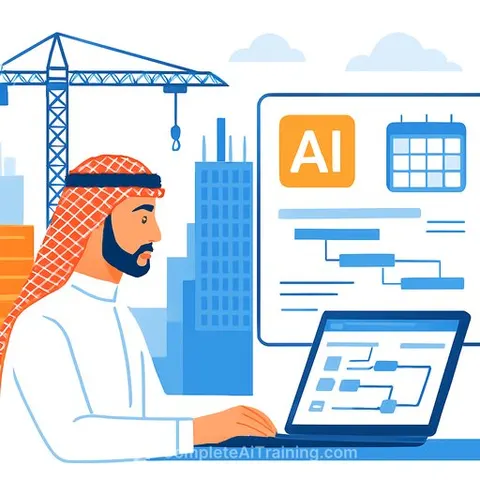
Saudi Arabia's Real Estate Sector Turns to AI for On-Time Project Delivery
Saudi Arabia's major real estate developers are moving AI from pilot projects into daily construction operations, using the technology to recover lost time on complex developments and manage the logistical demands of Vision 2030's giga-projects.
Contractors and consultants across the Kingdom now routinely deploy AI to optimize schedules, identify supply chain risks and respond to delays faster than traditional project management allows. The shift reflects a broader recognition that AI's value lies not in experimentation, but in measurable outcomes on active job sites.
How AI Recovers Lost Time
JLL, the real estate services firm, is supporting construction of a large-scale city development in Saudi Arabia currently in infrastructure and early vertical construction phases. The company uses ALICE Technologies, an AI platform that runs millions of simulations to test construction scenarios and identify the most efficient delivery strategies.
According to ALICE Technologies, the platform can reduce construction timelines by up to 17 percent and labor costs by 14 percent. JLL reports that comparable projects using the tool have recovered between 30 and 60 days of schedule time that would otherwise have been lost to delays.
Matthew Marson, managing director at JLL EMEA, said the real test of AI adoption is whether organizations can deploy it strategically enough to generate measurable results. "On a project of this scale, even a minor delay in one area can create significant ripple effects, impacting timelines and budgets across the entire development," he said.
Real-Time Response to Supply Chain Disruption
The value of the approach became clear when a key supplier reported a multi-week shipping delay that threatened to create a bottleneck during a critical phase. Under conventional project management, such a disruption would trigger weeks of manual rescheduling as teams coordinated subcontractors, revised dependencies and redistributed resources.
Instead, project managers entered the updated timeline constraints into the AI platform. Within hours, the system processed the downstream effects of the delay and generated a revised, optimized plan-work that would traditionally take weeks of manual effort.
The system resequenced tasks that could be completed earlier, adjusted resource allocations and updated schedules across the supply chain network. The project absorbed the disruption with minimal impact.
The Gap Between Strategy and Implementation
JLL estimates that 70 percent of commercial real estate activities could be supported by AI by 2030. Yet the firm's research shows a significant implementation gap: 82 percent of corporate leaders view AI strategy as critical, but only 24 percent have actually deployed AI across their organizations.
Successful AI adoption in real estate requires more than access to advanced technology. Industry experts point to the need for reliable data, strong governance, organizational readiness and leadership capable of integrating AI into core business decisions. Without these foundations, AI risks remaining a vendor-driven experiment rather than a practical tool for improving project delivery.
The clearest gains appear in areas where complexity is highest and outcomes can be directly measured: construction scheduling, resource planning, predictive maintenance, asset performance and portfolio analysis.
What AI Won't Do
AI is unlikely to replace human judgment in real estate development. What it does provide is faster visibility into risk and a wider range of responses when conditions shift unexpectedly.
For Saudi Arabia's rapidly evolving built environment, that may prove to be AI's most immediate and practical value. The next phase of adoption will be measured not by how many companies experiment with AI tools, but by how effectively they use them to keep projects on track.
Learn more about AI for Real Estate & Construction and AI for Operations.