
AI news ·
Scientists examine animal cognition and AI intelligence as human-centered assumptions face new scrutiny
NIH awarded more than half fewer competitive grants through March 31 compared to last year, cutting 2,700+ projects. Women's health research took the hardest hit, dropping 31 percent.
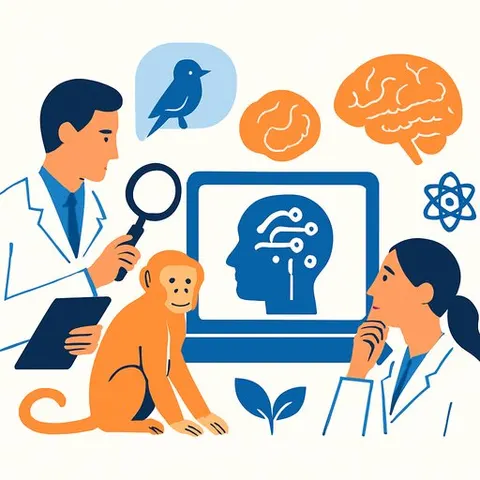
How We Study Animal Minds May Shape How We Understand AI
Scientists studying honeybees, parrots, and ravens are uncovering a principle that could reshape how researchers evaluate artificial intelligence: perspective matters. When researchers center their own sensory experience instead of the subject's, they systematically misread what's actually happening.
A new study from Monash University confirmed that honeybees process numerical information-settling an international debate about whether they were doing math or just reacting to visual patterns. The difference came down to experimental design. When researchers tested bees using stimuli aligned with how bees actually perceive the world, the evidence for numerical cognition strengthened.
"We must put the animal's perspective first when assessing their cognition or we may under or overestimate their abilities," said Dr. Howard in the research. "We see and experience the world quite differently from animals, so we must be careful of centering human perspectives and senses when studying animal intelligence."
Disability and Innovation
Bruce, a 13-year-old kea parrot missing his beak, designed and built his own prosthetic. Then he became the alpha male of his group by learning to joust, according to research published in Current Biology.
The findings add to a small but growing body of work showing how animals with disabilities adapt. Alice Auersperg, a cognitive biologist at the University of Veterinary Medicine Vienna, noted the gap in research: "The link between innovation and disability in animals is important and completely understudied."
Humans are responsible for many of these disabilities-from pollution-caused birth defects to injuries from traps, electrocution, and road accidents.
Personality Shapes Survival
Fan-tailed ravens at the Dead Sea display consistent individual personality differences that determine how they respond to human encroachment, according to research in Ecology Letters. As tourism and development expand into natural habitats, some ravens take greater risks than others-and those differences have life-or-death consequences.
The study combined lab-based behavioral tests with real-world movement data. One author noted: "This study highlights how integrating lab-based behavioral assays with real-world movement data can reveal patterns we would otherwise miss."
Environmental Toxins Reaching Wildlife
Swedish salmon dosed with cocaine swam faster and traveled farther than sober fish, according to a study published in Current Biology. The research examined how waterways polluted with illegal drugs affect freshwater species.
Obtaining permission to conduct the study required navigating local regulatory bodies. The work raises questions about how human drug habits are affecting salmon and other fish populations.
AI Writing About AI: A Problem Worth Watching
AI agents now have their own social network. Agent4Science, described as a Reddit-style site, allows purpose-built AI systems to share, debate, and discuss research papers. Human researchers can observe but not participate.
The platform raises a question worth examining: who is writing the promotional text about AI research? A review of science news sites shows repetitive phrasing in blurbs describing AI studies-suggesting AI may be writing promotional material about itself.
This matters because it obscures where information originates. The practice isn't inherently wrong, but it deserves transparency. Readers should know when AI has written the summary of AI research.
The "It's Not X, It's Y" Problem
LinkedIn is saturated with posts using a specific sentence structure: "This isn't a job, it's a calling" or "This isn't marketing, it's a movement." Cognitive psychologists have identified this as a recognizable pattern of AI-generated text.
The structure fails because negation doesn't work the way writers intend. When someone tells you what something isn't, your brain processes the negated concept first-making it stick harder. A 2004 social psychology study showed why some negations fail more than others.
Dozens of posts using the same negation-reframe structure create dozens of instructions to think about the thing the writer wanted you to forget.
Funding Cuts Hit U.S. Research
The National Institutes of Health awarded more than half fewer competitive grants through March 31 compared with the same period last year, according to a Washington Post analysis. The NIH supported over 2,700 fewer scientific projects in fiscal 2025-a 15 percent cut in competitive grants.
Women's health research took the largest hit, with a 31 percent drop in projects including the word "women" after years of steady growth. Biomedical funding has shifted, cutting the U.S. research footprint across nearly every major disease area, including cancer and mental health.
The National Science Foundation is distributing grants unevenly despite Congressional direction to equitably fund all basic-research directorates. The biological-sciences directorate would receive roughly 25 percent less than in 2025, while the social, behavioral and economic sciences directorate faces a 30 percent cut.
Scientists Missing or Dead
At least 10 individuals connected to sensitive U.S. nuclear and aerospace research have died or disappeared in recent years. The group includes a nuclear physicist and MIT professor shot outside his Massachusetts home, a retired Air Force general missing from New Mexico, and an aerospace engineer who vanished during a Los Angeles hike.
The FBI is investigating whether the cases are connected, working with the Department of Energy, Department of Defense, and state and local law enforcement.
Other Science This Week
HEPA filters and brain function: Adults over 40 who used an in-home HEPA air purifier for one month showed small but significant improvements in brain function, according to a study in Scientific Reports. Exposure to particulate matter has been linked to respiratory, cardiovascular, and neurological diseases including Alzheimer's and Parkinson's.
How breathing began on land: A 289-million-year-old mummified reptile found in an Oklahoma cave reveals the earliest known example of the breathing system used by amniotes-a group that includes reptiles, birds, mammals, and their ancestors, among the first animals to fully adapt to land.
Antimatter transport: Scientists at CERN successfully transported antiprotons in a truck across the facility's main site on the France-Switzerland border. The team accumulated antiprotons in a portable cryogenic Penning trap, disconnected it from the experimental facility, loaded it onto a truck, and continued experiments after transport. The goal is to eventually move antiprotons from CERN's antimatter factory to other European laboratories for precision measurements.
Knotted robots: Soft robots made from knotted material can leap nearly two meters into the air-hundreds of times their own size-by releasing stored tension. The design allows the robots to jump, flip, spin, or glide, according to Penn Engineers.
Bering Strait dam proposal: Two Dutch scientists published a study in Science Advances proposing a 50-mile dam across the Bering Strait to prevent collapse of the Atlantic Meridional Overturning Circulation, a network of ocean currents central to regulating Earth's climate.
Finding Reliable Information Online
Google's AI summaries now dominate search results, making it harder to find human-written information. One workaround: click "Tools" at the top of search results, select "All Results," then choose "Verbatim." This filters out AI-generated summaries and returns only human-written content.
The degradation of online information quality-what researchers call "enshittification"-extends beyond search. Recipe blogs alter traditional recipes to follow influencer trends. Gardening information from unknown sources becomes unreliable. Sunset Western Gardening, once the standard reference for California gardeners, went out of print over a decade ago. Used copies now sell for $30 to $150.
Wikipedia, despite its flaws, increasingly offers more reliable information than algorithm-driven results because human editors vet content and include citations.
For researchers and professionals, this shift means returning to primary sources and published references-the same standards that built scientific credibility before search algorithms optimized for engagement over accuracy.