Researchers Use AI to Redesign Bacteria That Function Without a Standard Amino Acid
Scientists have engineered a bacterium to survive without one of the 20 amino acids that almost all life on Earth uses to build proteins. The work, published in Science on April 30, represents the first time researchers have successfully removed a fundamental building block from a living organism's essential machinery.
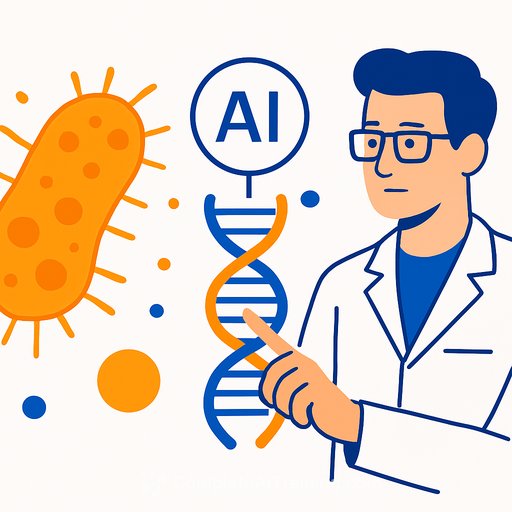
The team, led by Harris Wang at Columbia University, used Google DeepMind's AlphaFold2 to redesign ribosomal proteins-the cellular factories that manufacture all other proteins. They replaced isoleucine, an amino acid, with structurally similar alternatives in 21 of the 50-some ribosomal proteins.
The resulting bacterial strain, called Ec19, maintained its genetic changes for over 450 generations. This stability suggests that proteins can function with fewer building blocks than previously thought possible.
Why This Matters for Understanding Early Life
The findings offer clues about what Earth's earliest organisms may have looked like. Life today uses 20 amino acids-some organisms use one or two more, but none use fewer. Early life forms may have relied on a simpler set of building blocks before evolution expanded the full palette.
"Even for very large machines like the ribosome, you don't necessarily need to paint with all 20 colors," said Tom Ellis, a synthetic biologist at Imperial College London who was not involved in the study.
How AI Solved a Design Problem
Wang's team initially tried replacing isoleucine with valine or leucine by introducing the genetic changes directly into E. coli. Only 43 percent of the bacteria survived.
The researchers then used AI models to generate designs that preserved protein structure and function while accommodating the missing amino acid. "Some of these AI designs were really surprising," Wang said. "They didn't look like anything we would have anticipated."
The team validated each AI-suggested design before testing it in living cells. This iterative approach proved far more effective than manual engineering.
The Limits and Next Steps
The researchers could not combine all the redesigned ribosomal proteins in a single cell. Kaihang Wang, a synthetic biologist at Caltech, called the work "a first baby step of a grand journey" toward creating a fully functional cell that runs on fewer amino acids.
Christopher Snow, a protein engineer at Colorado State University, said the study is "very impressive" and helps "deepen the understanding of the design rules of life."
The work opens new avenues for research in synthetic biology. Understanding which constraints can be relaxed in cellular machinery could inform efforts to design organisms with novel properties or to create life forms with simplified biochemistry.
Learn more about how AI is applied in scientific research through AI for Science & Research courses.
Your membership also unlocks: