Why 90% of AI agent deployments start with customer service
Customer service is where AI proves itself fast. That's why, across Salesforce's Agentforce deployments, roughly 90% of go-lives start with Service Cloud. It's visible, measurable, and it hits cost and experience at the same time.
In Amsterdam, Salesforce's Chief Customer Officer for Service Cloud, David Brown, shared what's working right now: autonomous agents that resolve real cases, AI features that shave minutes off every interaction, and a clear shift in channel strategy that's changing how support teams operate.
Why service gets AI first
Service use cases are concrete. You can quantify deflection, handle time, and CSAT within weeks. That's why teams typically start in chat with simple FAQs, then move quickly to agents that take actions-processing requests, completing workflows, and solving end-to-end issues.
Once leaders see early wins, approvals get easier. The pipeline fills with more advanced use cases that tap into CRM data and back-end systems to actually do the work, not just answer questions.
Beyond chatbots and IVR
Let's be honest: "I think the only thing disliked more than a chatbot is IVR." Static trees and "press 2 for…" logic are on their way out. Modern agents handle conversation, context, and tasks.
Salesforce moved help.salesforce.com onto Agentforce. The result: 86% of cases are resolved with an autonomous agent, with higher customer satisfaction because answers land faster. No channel hopping. No handoffs. That level of containment also drives serious cost savings.
Quick wins you can ship this quarter
You don't need full autonomy on day one to see results. Basic AI features already pay off:
- Call and chat summarization that saves minutes of note-taking after each interaction.
- AI-powered reply suggestions ("Service Reply") trained on your knowledge base, improving average handle time by up to 45% for some teams.
- Real-time prompts during conversations so agents don't dig for docs or macros.
These are simple to implement and easy to prove out with a pilot group.
Multilingual support and translation
Language coverage is expanding. English is generally available. French, Spanish, German, and Portuguese are next, with Dutch following soon after. That matters if you run support across multiple markets.
The bigger shift is translation. If an agent can hold a high-quality conversation in any language, location becomes less of a constraint. It changes how you think about outsourcing, staffing, and follow-the-sun coverage.
Field example: Heathrow's "Haley" on WhatsApp
Heathrow Airport launched an autonomous Agentforce assistant called Haley. She handles wayfinding, gate info, lounges, and even airline menus-all inside WhatsApp.
Early impact: a 40% reduction in human-handled chats for those repeat, low-value questions. That frees agents to focus on irregular ops and higher-stakes traveler issues while improving the passenger experience in the moment.
Channel strategy: fewer channels, better outcomes
Here's the data point most teams miss. In Salesforce's latest State of Service report, based on 6,500 respondents, fewer than 10% of companies have a real channel strategy. Many assume "more channels = better." The best performers do the opposite: they match channels to use cases.
Simply Health is a live example. They're moving phone from about 70% of inbound volume to roughly 10% over three years, while WhatsApp grows from 5% to around 50%. AI is enabling that shift by handling volume where customers already are-and where automation can actually do the job.
If you spread thin across every channel, you dilute quality. Pick the right channels, then go deep with automation, routing, and measurement.
From cost center to revenue
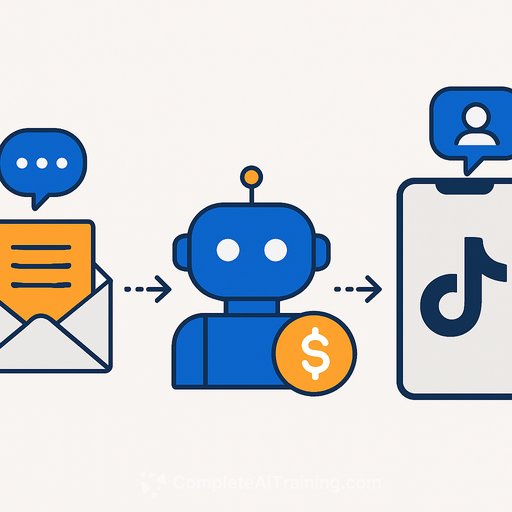
Once the service agent is effective in support, teams are starting to put that same "product expert" in front of campaigns. One electronics retailer in Germany removed the classic "do not reply" line and invited customers to ask questions directly from the email.
That move turns service into lead nurture. Your team stops being just a cost and starts influencing conversion, AOV, and retention. It's a practical path to make service part of revenue-and it uses the same knowledge base you've already built.
How to implement Agentforce without the chaos
- Start narrow: one channel, three use cases (FAQ + one transactional workflow + one policy edge case).
- Wire it to source of truth: CRM records, order data, and your knowledge base. If the KB is outdated, fix that first.
- Set guardrails: clear intents, confidence thresholds, safe actions, and graceful human handoff.
- Instrument everything: resolution rate, containment, average handle time, time to first response, CSAT.
- Pilot, then expand: move from info-only to action-taking agents (refunds, appointment changes, claims checks) as accuracy proves out.
- Train the team: show agents how to review AI suggestions, edit replies, and escalate with context.
- Build a review loop: weekly quality audits on conversations, outputs, and accuracy. Close the loop with KB updates.
- Plan languages: prioritize markets, define translation posture (agent vs. human), monitor quality by locale.
- Make a channel plan: decide what gets automated in chat/WhatsApp, what stays on phone, and what belongs in email.
- Graduate to revenue: once support stabilizes, put your product expert agent in front of marketing campaigns.
Metrics that matter
- Autonomous resolution (containment) rate and deflection volume.
- Average handle time and wrap-up time (post-call work).
- First response time and queue wait times by channel.
- CSAT by intent, not just by channel.
- Agent effort: how often AI suggestions are accepted, edited, or rejected.
- Cost per contact and savings tied to specific use cases.
- For revenue pilots: influenced pipeline, conversion rate, and incremental sales.
Trust, accuracy, and handoffs
Accuracy earns trust. Trust earns scale. Set conservative thresholds early, make it easy to route to a human, and log every action an agent takes. Every week, review failures, clarify intents, and update the knowledge base.
Customers forgive an honest handoff faster than a confident wrong answer. Keep outputs grounded in your data. Keep explanations simple. And always make it obvious how to reach a person.
What this means for support leaders
Service is the logical first step for AI agents because ROI is clear and fast. The playbook is consistent: start in chat or messaging, automate the top five intents, add safe actions, then scale across languages and channels with a real strategy.
As your agent gets good, redeploy it at the top of the funnel. That's how service shifts from cost to growth without adding headcount.
Resources
- Salesforce Agentforce overview
- Salesforce State of Service (latest report)
- AI training paths for customer support roles
Bottom line
Start where impact is obvious. Prove it with one channel, a tight set of use cases, and hard numbers. Then scale the agent, refocus your channels, and let your service team do more than answer tickets-they can drive the business.
Your membership also unlocks: