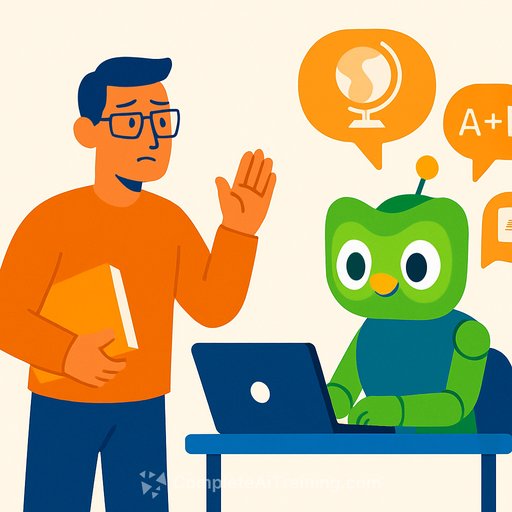
Duolingo's CEO Claims AI Will Replace Teachers — But Should It?
Luis von Ahn, founder and CEO of Duolingo, recently sparked debate by suggesting that artificial intelligence will soon replace human teachers. His argument centers on AI’s ability to personalize learning better than humans, promising improved educational outcomes. However, he also acknowledges that schools will continue to exist primarily for childcare.
These comments come alongside Duolingo’s new AI-first strategy, which involves replacing contract employees with AI and launching 148 new courses powered by generative AI. The move has triggered backlash among users, who criticized the decision and even deleted the app. Amid the controversy, Duolingo temporarily removed its social media posts and later released a cryptic video addressing the uproar.
AI as a Teaching Tool: Marketing or Reality?
Experts caution that von Ahn’s bold claims should be seen as marketing rather than an established fact. Matthew Guzdial, assistant computing science professor at the University of Alberta, points out that there is no solid scientific evidence proving AI teaches better than human instructors. Many studies Duolingo cites are small in scale and funded by the company itself, raising questions about their reliability.
A 2021 meta-analysis published in Computer Assisted Language Learning found that while Duolingo showed positive impacts on language skills, the results were debatable due to limited sample sizes and overlooked variables like motivation and demographics. This suggests that, despite promising signs, conclusive proof of AI’s superiority in teaching remains lacking.
Is AI Actually a Better Teacher?
While AI has proven useful in certain educational contexts, experts emphasize it cannot fully replace human teachers. Guzdial highlights that AI tools like ChatGPT can provide answers but don’t ensure real understanding or knowledge retention. Learning requires active mental engagement, not just quick access to information.
Research supports this nuanced view. AI can enhance education by automating routine tasks, clarifying concepts, and identifying students who need extra help. However, a 2023 literature review and a 2024 study both confirm that AI complements rather than substitutes human judgment and expertise. The latter study even found that students who felt more socially supported by humans performed better academically.
Even AI models acknowledge their limitations. Asked whether AI is a better teacher than humans, ChatGPT responded that it functions best as a support tool, helping educators focus on inspiring and mentoring students rather than replacing them.
The Impact on Jobs and the Education Sector
Von Ahn argues that AI’s ability to offer individualized attention surpasses what any teacher can provide in a classroom. Duolingo’s CFO echoed this, stating their AI aims to replicate the benefits of a good tutor by identifying weaknesses and keeping learners engaged.
However, this shift raises concerns about job displacement, especially since teaching is a predominantly female profession. The broader AI impact on employment is uneven, with roles historically held by women facing higher vulnerability. Recent incidents, such as the Chicago Sun-Times publishing an AI-generated reading list filled with non-existent books, highlight the risks of over-relying on AI without adequate oversight.
What Executives Should Take Away
- AI has potential to improve education by delivering personalized support and automating repetitive tasks.
- Human teachers provide irreplaceable value in mentorship, social support, and nuanced judgment.
- Claims about AI fully replacing teachers lack strong evidence and may be driven by marketing strategies.
- Organizations must weigh AI’s benefits against ethical and workforce impacts, especially in sectors with vulnerable employee demographics.
- Successful AI integration requires a balanced approach that enhances human roles rather than eliminates them.
Executives and strategists should view Duolingo’s AI-first move as a signal of where education technology is heading but remain critical of sweeping statements about AI’s ability to replace human expertise. For companies exploring AI’s role in learning and development, understanding its strengths and limitations is key to making informed decisions.
For those interested in practical AI applications and training, exploring Complete AI Training’s latest courses can provide valuable insights into how AI tools can be effectively integrated without sidelining human talent.
Your membership also unlocks: