Integrating AI for Customer Service Into Support Agent Training: Yay or Nay?
Customers want answers fast. Queues stack up. Teams feel the squeeze. Turning to AI feels obvious - and it is. Eighty-eight percent of organizations use AI in at least one function, according to a recent report from McKinsey.
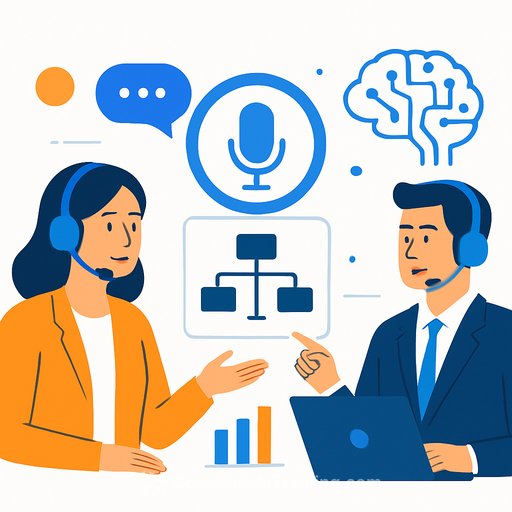
But here's the shift: AI isn't just for chatbots and ticket deflection. AI for Customer Support can train agents, too. Not to replace them - to prepare them for real conversations, with better reps and faster ramp-up.
Why AI belongs in agent training
Think of AI as a practice partner. Just like students use it to study smarter - to test themselves, build scenarios, and stress their thinking - support teams can use it to improve communication, empathy, and problem-solving. Strong training raises performance within 90 days. If AI helps you get there faster, use it.
High-impact ways to deploy AI in training
- Simulations: Create realistic customer interactions across chat, email, and voice. Let agents practice the hard stuff before they see it live.
- Scenarios: Run varied scripts - angry customer, confused customer, VIP customer, outage escalation - so agents learn to respond with context, not templates.
- Instant, data-driven feedback: Score clarity, tone, empathy, accuracy, and compliance in real time. Correct in the moment, not weeks later.
- Adaptive training: Personalize modules to focus on each agent's weak spots and goals. No wasted time.
Bonus: AI keeps training consistent. Every agent gets the same structured content, tone analysis, and clear standards. It also scales without blowing up your budget or calendar:
- More agents can train at the same time.
- Agents can train on their schedule, not the trainer's.
- Coaches can spend time on higher-order reviews, not repeating basics.
Where AI still falls short
1) Human nuance
AI still misses emotional subtleties. One high-profile case showed a chatbot spiraling when pushed by a frustrated user. That's a reminder: build training modules that pressure-test edge cases, ambiguity, and emotion - and coach agents to lead with judgment.
2) Cultural and contextual blind spots
Models reflect their training data. They can misread tone, sarcasm, or politeness across cultures. Case in point: research showed chatbots misinterpreting Persian etiquette, reading a polite "no" as a "yes." For global teams, bake cultural context into scenarios and set region-specific benchmarks.
3) Over-reliance
If agents only follow prompts, they don't develop judgment. Train with and without AI. Test agents on messy, novel cases. Make independent decision-making a scored skill.
4) Ethics and privacy
Personalized training needs performance data - calls, chats, tone, timing. If it looks like surveillance, morale and performance drop. A Cornell study found workers under AI monitoring complained more and performed worse. Use transparent scoring, avoid "black box" labels, and collect only what you need.
Make AI a co-pilot, not a crutch
In live operations, the same blockers show up over and over:
- Repetitive questions eat hours.
- Admin tasks pull focus.
- Knowledge is scattered across tools.
- Tier handoffs are inconsistent.
- Urgent cases aren't prioritized early enough.
- Onboarding is slow and manual.
Configured well, AI can tag and route tickets, auto-draft replies, surface the right article, and pull context instantly. Studies show up to a 13.8% productivity lift - that's more tickets per hour without burning people out.
The best model: AI drafts, agents decide. AI suggests responses and highlights key details. Agents add nuance and make the call. Quality stays high; time to resolution drops.
Draw the line: Yay, nay, or both?
AI isn't perfect. It needs oversight. But used with intent, it speeds up learning and improves daily execution. Treat it like a skilled assistant - great at repetition and pattern recognition - guided by humans who bring context, empathy, and accountability.
Where AI excels
- Scaling practice and onboarding
- Consistent standards and feedback
- Automating repetitive workflows
- Surfacing knowledge on demand
Where humans must lead
- Emotion, de-escalation, and rapport
- Exception handling and edge cases
- Policy interpretation and tradeoffs
- Ethical decisions and accountability
Human support vs. Human + AI support
Human support only
- Cost: Higher - more staff hours, longer training, manual tasks.
- Training speed: Slower - feedback loops are delayed; proficiency takes longer.
- Onboarding time: Longer - systems and processes learned by hand.
- Response speed: Slower - manual search, writing, and routing.
- Consistency: Variable - depends on individual skill and memory.
- Scalability: Limited - adding volume requires more headcount.
Human + AI support
- Cost: Lower per ticket - automation trims repetitive work; potential ~30% budget savings depending on mix and volume.
- Training speed: Faster - simulations, adaptive modules, and instant feedback compress ramp time.
- Onboarding time: Shorter - guided workflows and real-time prompts.
- Response speed: Faster - AI drafts replies, surfaces knowledge, tags, and routes.
- Consistency: Higher - standardized tone checks and process adherence, with human judgment on edge cases.
- Scalability: High - training and ops scale with demand; more agents can train simultaneously.
A practical rollout plan
- Audit first: List top repetitive questions, slow handoffs, and common training gaps.
- Define metrics: Target first-response time, handle time, CSAT, QA pass rate, and ramp-to-proficiency.
- Start low-risk: Use AI for simulations, knowledge surfacing, and drafting (not auto-send) in early phases.
- Build a scenario library: Include cultural variants, emotional intensity levels, and policy edge cases.
- Close the loop: Give instant feedback, then sample 1:1 coaching with human review. Calibrate often.
- Prevent over-reliance: Run "AI-off" drills. Score independent reasoning.
- Set guardrails: Explain what data is collected, why, and how it's used. Allow opt-outs where possible.
- Train the trainers: Teach managers to read AI feedback, adjust prompts, and tune scenarios - consider the AI Learning Path for Training Coordinators as a practical guide.
- Iterate: Track results weekly. Keep what moves KPIs; cut what doesn't.
Bottom line
AI can sharpen skills, speed up workflows, and take the grunt work off your team's plate. It won't replace empathy or judgment - and you don't want it to. Pair AI with strong coaching and clear standards, and your support org gets faster, smarter, and more consistent without losing its human edge.
If you're building a training stack and want a curated place to start, explore the AI Learning Path for Training & Development Managers.
Your membership also unlocks: