Siemens and GlobalFoundries partner to advance AI-driven semiconductor manufacturing
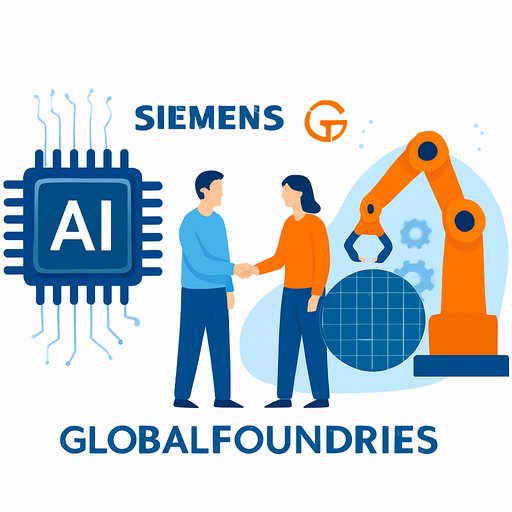
Siemens and GlobalFoundries (GF) have signed a memorandum of understanding to bring AI deeper into semiconductor manufacturing. The goal: improve efficiency, security, and reliability across design, fabrication, and lifecycle management while meeting rising demand for chips used in AI, defense, energy, and connectivity.
The collaboration will focus on automation for fabs, electrification, and digital solutions that connect chip design to product lifecycle management. Expect AI-enabled software, sensors, and real-time control to sit at the core of centralized automation and predictive maintenance initiatives.
What the partnership covers
The companies plan to deploy AI-enabled control systems and analytics in fabrication plants to increase equipment availability and operational efficiency. Centralized automation and predictive maintenance are core components, aimed at higher throughput, fewer unplanned stops, and better process stability.
Both firms will implement these capabilities in their own operations first, then create offerings that can scale to other industries. The emphasis is on practical wins that translate to measurable impact on yield, cycle time, and cost per wafer.
Why this matters for product and operations leaders
- Throughput and yield: AI-driven control loops and sensor intelligence can reduce drift, scrap, and line stoppages-moving key metrics in weeks, not quarters.
- Reliability: Predictive maintenance can lift equipment availability and extend asset life by addressing failures before they disrupt critical runs.
- Security and resilience: Locally manufactured, secure chips support government and enterprise needs while stabilizing supply during demand spikes.
- Faster concept-to-ramp: Linking design tools with fab automation and PLM shortens feedback cycles and helps teams catch issues earlier.
- Energy and cost control: Electrification and data-driven optimization target utilities and consumables-often overlooked levers in margin improvement.
Where Siemens and GF bring leverage
Siemens will contribute its industrial automation, energy management, and digitalization portfolio, including advanced software for chip design, fab automation, and lifecycle management. The intent is a connected stack-design to production-with real-time insights and closed-loop control.
GF, together with its subsidiary MIPS (a leader in RISC-V processor IP), will provide process technology and design expertise to accelerate solutions for autonomous platforms and physical AI chips at scale. GF operates manufacturing facilities in the United States, Asia, and Europe; its Dresden site is Europe's largest semiconductor production hub with around 3,000 employees.
What they said
"Our economy runs on silicon - one wafer at a time. Chips are critical for applications like robotics or connectivity and for bringing AI into the physical world and industry," said Cedrik Neike, Member of the Managing Board of Siemens and CEO of Digital Industries.
"Secure, locally manufactured semiconductors are at the core of the AI transition - from cloud to the physical world, bringing intelligence into devices we use every day and enabling applications we couldn't imagine a few years ago. Our unique collaboration with Siemens allows us to go faster - to build the technologies that make this possible - differentiated, energy-efficient, connected and secure chips across a wide range of next-generation applications," said Tim Breen, CEO of GlobalFoundries.
What to do next
- Run a quick diagnostic: sensor coverage, data quality, historian access, and current OEE trends. You can't optimize what you can't see.
- Pick one high-impact pilot: predictive maintenance on a bottleneck toolset or AI-based process control on a yield limiter. Define clear success metrics (availability, defect density, cycle time).
- Tighten the digital thread: connect design, manufacturing, and PLM so lessons from production feed back into design and change control without delay.
- Review security posture early: AI plus more data flow means more surfaces to protect across fabs, edge devices, and cloud endpoints.
- Plan for adoption: upskill your teams and document new workflows so wins scale beyond a single line or site.
Context
Demand for semiconductors is surging across AI, defense, energy, and connectivity. By pairing Siemens' automation and software stack with GF's manufacturing footprint and chip expertise, the collaboration aims to speed innovation while strengthening supply chain resilience.
For more on each company's capabilities, see Siemens Digital Industries and GlobalFoundries. If you're building a skills plan for your team, explore practical programs at Complete AI Training.
Your membership also unlocks: