Singapore launches supercomputer to accelerate AI research across region
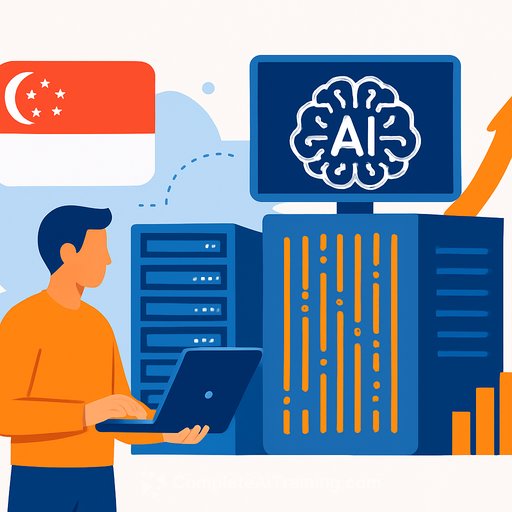
Singapore opened ASPIRE 2B on Monday, a national supercomputer designed to support advanced AI research and high-performance computing. The system represents a 100-fold increase in computing capacity compared with ASPIRE 1, which launched a decade ago.
The National Supercomputing Center Singapore (NSCC) operates the new system, which is equipped with more than 1,500 Nvidia H200 graphics processing units and can deliver up to 115 petaFLOPs of computing power.
Minister for Digital Development and Information Josephine Teo said the infrastructure upgrade supports Singapore's next phase of AI development under the National AI Strategy 2.0. The government has committed more than S$1 billion ($780 million) to fundamental and applied AI research.
Research focus and practical applications
NSCC currently supports more than 700 active users and around 9,000 researchers, students and industry participants across Singapore's higher education and research institutions. Since 2024, the center has supported more than 1,500 projects spanning scientific research and industrial applications.
Maritime engineering company Mencast used NSCC resources to develop an AI-powered platform for marine propeller design. The platform allows engineers to generate and evaluate more than 10,000 design variations within days, compared with about 20 designs previously developed over several weeks.
Climate research stands to benefit significantly from the increased computing power. Singapore's Third National Climate Change Study used NSCC resources to develop high-resolution climate models for the country's urban environment. With ASPIRE 2B, researchers can combine AI techniques with physics-based simulations to generate more detailed climate forecasts and improve understanding of rising sea levels and extreme rainfall.
Another priority is developing AI models that reflect Southeast Asia's linguistic and cultural diversity. A*STAR's SEA-LION and MERaLiON models were designed to understand the region's more than 1,000 languages, capabilities increasingly important for companies deploying AI solutions across Southeast Asia.
Quantum integration and infrastructure strategy
NSCC plans to integrate a quantum computer with ASPIRE 2B later this year, creating a hybrid computing environment. While practical applications remain emerging, the integration could help researchers explore molecular simulations and advanced materials research.
Teo stressed that hardware capacity alone would not determine success. "As AI systems become more sophisticated, capabilities will matter just as much as capacity," she said, pointing to next-generation technologies such as agentic AI and physical AI that will require significantly greater computing resources.
She called on NSCC to strengthen user support, helping researchers, students and companies make effective use of advanced computing resources. "Our measure of success cannot be limited to the scale of hardware. What matters is how well we use the infrastructure - efficiently, effectively, and in service of the research community."
People, skills and collaboration remain essential in translating computing power into practical outcomes, including better climate models, medical breakthroughs and industrial innovation.
More than 70 companies have established AI Centers of Excellence in Singapore, while global AI research organizations including Google DeepMind and Microsoft Research Asia have set up regional teams in the country. A National AI Council chaired by Prime Minister Lawrence Wong will oversee AI initiatives across connectivity, advanced manufacturing, healthcare and finance - sectors that together account for more than 40 percent of Singapore's gross domestic product.
For researchers building expertise in AI applications, AI for Science & Research courses can provide foundational knowledge in using AI tools for scientific discovery.
Your membership also unlocks: