
AI news ·
Smart technologies turn chaotic airport terminals into data-driven hubs
Airports are using AI-driven computer vision to track every ramp vehicle and flag delays before they cascade, preventing costly late departures. The technology also analyzes sensor data from thousands of conveyor gearboxes to predict equipment failure and schedule off-peak repairs.
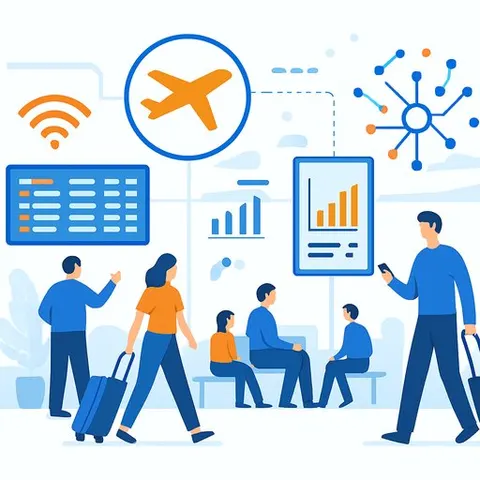
Airport operators are deploying artificial intelligence across terminals and tarmacs to cut delays, prevent equipment failures, and redesign infrastructure. The shift moves daily operations from reactive guesswork to real-time, data-driven orchestration - directly affecting throughput, staffing, and capital planning.
The predictive apron catches delays before they cascade
The tarmac is an airport's most unpredictable zone. A single delayed catering truck or a slow fuel hookup triggers a costly cascade of late departures. AI-driven computer vision now tracks every moving asset on the ramp using existing terminal cameras. Machine learning models recognize fuel trucks, baggage tugs, and catering carts instantly. If the system detects that a fueling bridge has not connected to an aircraft ten minutes after arrival, it flags the anomaly to ground controllers so teams can intervene before the delay hits the scheduled pushback time.
Higher in the operational stack, machine learning also handles stand and gate allocation. The software constantly recalculates flight trajectories, taxi speeds, and baggage unloading times instead of relying on fixed gate schedules. When an incoming flight faces a headwind, the system dynamically swaps its assigned gate with an on-time aircraft. This optimization increases gate utilization, cuts taxi-in fuel burn, and eliminates planes waiting on the tarmac for a gate to open.
Pre-emptive maintenance replaces run-to-failure cycles
For years, airport maintenance followed a simple rule: fix things on a set schedule, or wait until they broke. Both approaches waste time and money. Inside the baggage system, thousands of vibration and heat sensors now monitor conveyor gearboxes continuously. AI learns the sound signature of smooth operation. When a component begins to wear - producing a hum no human can detect - the system flags it. Crews swap the part during off-peak hours, avoiding a terminal-wide disruption during the morning rush.
The same principle applies to airfield surfaces. Automated drones with advanced cameras map runways down to the millimeter. Smart software scans the images to catch microscopic cracks and ruts before they become hazards. Airports can then schedule targeted patches rather than shutting down an entire runway for emergency paving. This approach extends asset life and reduces unplanned downtime - a direct budget and scheduling win for operations teams. Professionals pursuing an AI Learning Path for Operations Managers often encounter these exact predictive maintenance patterns as foundational use cases.
Digital twins and generative design reshape infrastructure
AI is altering how airport infrastructure gets designed and expanded. Architects feed decades of passenger movement data, security processing speeds, and retail revenue metrics into generative AI software. The system simulates millions of structural variations, optimizing layouts to minimize passenger walking distances while maximizing foot traffic past retail and dining areas.
Once built, these facilities are managed through digital twins - real-time 3D virtual models of the physical airport. Every HVAC unit, escalator, people mover, and electrical substation streams data into the replica. When a heatwave is forecast, the digital twin runs predictive simulations to determine how the terminal's glass facade will affect internal temperatures. It adjusts cooling zones hours ahead, balancing passenger comfort with energy efficiency. The AI also coordinates solar arrays, battery storage, and electric ground fleet charging to draw grid power only during low-tariff, off-peak hours, cutting both carbon footprint and utility costs.
The term artificial intelligence itself is codified in 15 U.S.C. § 9401(3) as a machine-based system that, for a given set of human-defined objectives, makes predictions, recommendations, or decisions influencing real or virtual environments. In plain terms, AI software independently evaluates data, uncovers hidden patterns, and generates its own forecasts - a departure from rigid, pre-programmed commands.
Why this matters for operations teams
The real metric of success for these systems is invisibility. When AI runs at peak efficiency, flights depart on time, runways stay clear, and terminals maintain steady temperatures without manual intervention. For operations managers, the practical shift is this: raw operational data - camera feeds, sensor telemetry, flight trajectories - now feeds predictive models that flag problems before they become emergencies. The technology does not replace ground crews or maintenance teams. It gives them a decision-making window that did not exist before, converting airports from passive transit hubs into adaptive systems that engineer their own efficiency. AI for Operations is rapidly moving from pilot programs to standard infrastructure in high-throughput environments like aviation terminals.