Snake-like robot learns to switch gaits for twice the efficiency
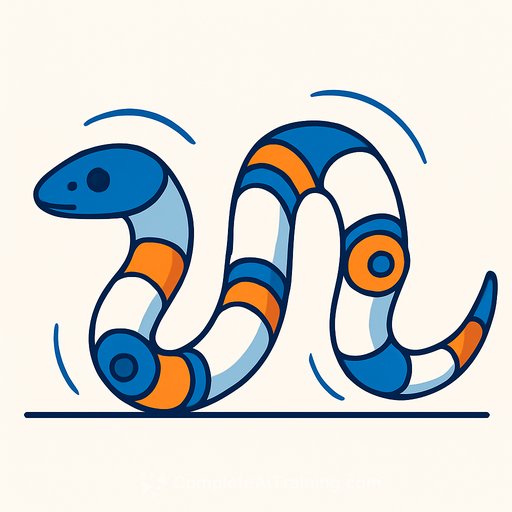
Researchers at Osaka Metropolitan University have trained a snake-like robot to choose between two movement patterns based on terrain, doubling its energy efficiency on flat ground. The robot uses deep reinforcement learning to optimize when to slither like a snake and when to roll like a wheel.
Snake robots are designed for rescue work in spaces too dangerous or narrow for humans-collapsed buildings, rubble, water surfaces. Their slender bodies fit where humans cannot. The problem: undulating motion requires multiple motors working in coordination, draining batteries quickly and limiting mission duration.
Dr. Akio Yamano's team found that rolling motion-where the robot forms a circular loop and shifts its center of gravity to roll forward-uses gravity instead of constant motor power. On level ground, rolling achieved roughly twice the speed per unit of power compared with undulating motion.
The system relies on what the researchers call an "observation buffer." Sensor data feeds information about angular velocity, acceleration, and body position into the learning algorithm, which stabilizes the rolling motion and ensures straight-line travel.
The most practical approach mixes both movements. The robot uses undulating motion on uneven terrain and switches to rolling on flat surfaces. This hybrid strategy extends operating time in disaster zones and could apply to planetary exploration missions where battery life determines mission success.
The research team plans to move beyond pre-programmed gaits. Future robots should assess terrain conditions automatically and select the most efficient movement without human input, Yamano said.
The study appeared in Robotics and Autonomous Systems.
Researchers working on similar problems may find value in exploring AI for Science & Research to understand how reinforcement learning applies to robotics optimization.
Your membership also unlocks: