
AI news ·
UCL researchers combine quantum computing with AI to improve predictions of complex physical systems
UCL researchers combined quantum computing with AI to predict chaotic systems 20% more accurately than standard models, using far less memory. The method could improve climate forecasts, fluid dynamics, and medical simulations.
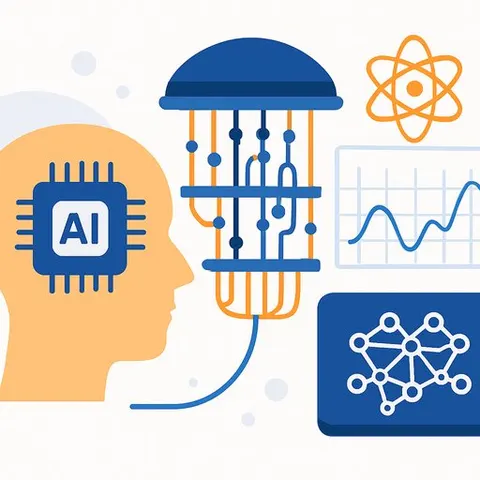
Quantum Computing Boosts AI's Ability to Predict Chaotic Systems
Researchers at University College London combined quantum computing with artificial intelligence to predict the behavior of complex physical systems with roughly 20 percent greater accuracy than conventional AI models. The hybrid approach, published in Science Advances, processes data through a quantum computer before training an AI model on classical hardware.
The method requires hundreds of times less memory than standard approaches, making it practical for large-scale simulations in climate science, fluid dynamics, medicine, and energy production.
How the Hybrid Method Works
The researchers used a quantum computer to identify statistical patterns in data that remain stable over time. These patterns then guided the training of an AI model running on a conventional supercomputer.
Unlike traditional computers that process bits as either 1 or 0, quantum computers use qubits that can exist in multiple states simultaneously. Qubits can also influence each other across distances, allowing a small number of qubits to represent an enormous range of possible states.
The approach avoids a major limitation of current quantum hardware: errors from noise and interference. By using the quantum computer once during the workflow rather than repeatedly exchanging data between quantum and classical systems, the method sidesteps these reliability problems.
Practical Advantage Over Simulation and Pure AI
Running a full simulation of complex systems like fluid flow can take weeks. Pure AI models are faster but become unreliable over longer time scales. The quantum-informed approach delivers speed and accuracy.
The researchers tested the method on a 20-qubit quantum computer at the Leibniz Supercomputing Centre in Germany. The system maintained stable predictions even when modeling chaotic systems.
Applications Across Science and Engineering
The method could improve climate forecasting, blood flow modeling, molecular interaction simulations, and wind farm design. Any field requiring predictions of how liquids and gases behave stands to benefit.
Researchers plan to scale the approach using larger datasets and apply it to real-world situations with greater complexity. A theoretical framework explaining why the method works is also in development.
Learn more about AI for Science & Research and how advanced AI systems are being enhanced with quantum capabilities.