
AI news ·
Social offloading emerges as AI handles employee-boss interactions
AI-to-AI messaging erodes management skills, warns Skillsoft's Leena Rinne. Meta cut 25,000 jobs and now targets a 50-to-1 engineer-to-boss ratio.
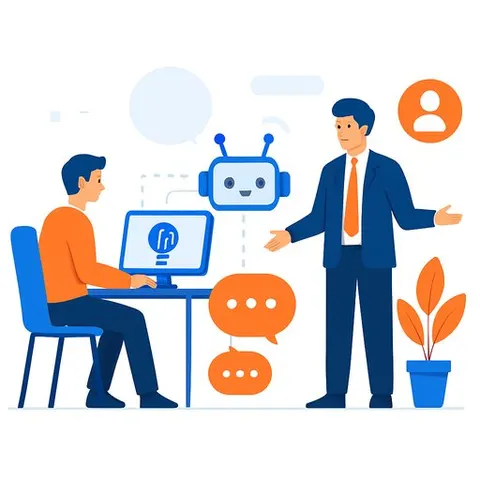
The practice of using AI to interpret and reply to AI-written messages between colleagues is hollowing out essential management skills, according to Leena Rinne, vice president of leadership, business, and coaching at Skillsoft. Rinne points to a growing phenomenon she calls "socially offloading"-outsourcing the human judgment, empathy, and courage needed for interpersonal interactions to technology-that threatens to erode the very relationships that make organizations function.
An employee told Rinne she received a message from her boss she did not fully understand. Suspecting it was written by AI, she asked her own AI tool to interpret it. The AI not only decoded the message but offered to draft a reply. The employee paused and realized, "I literally think [my boss'] AI is talking to my AI. That is the actual conversation happening right now," adding, "I can't crack the code of working with [my boss], because it's just his AI and my AI going back and forth."
Rinne defines this pattern as socially offloading, akin to cognitive offloading of menial tasks. It can surface in high-stakes moments: a boss preparing a performance review by asking AI how to deliver the message, or an employee having AI craft a reply to a tense email from a supervisor.
What gets lost when AI handles emotional intelligence
"If I'm always asking AI how do I respond to my boss, I don't actually learn how to engage with my boss. I don't actually learn how to build a relationship with my boss," Rinne said. The risk stretches beyond day-to-day exchanges. A Harvard Business Review analysis of AI usage patterns found that people increasingly use AI for therapy and companionship. Rinne warns that relying on machines for emotional intelligence work robs workers of the chance to build those muscles themselves. "The risk is then that we don't develop these critical skills that we can use in the moment, because we don't know how to navigate emotional intelligence, if AI is navigating emotional intelligence for us," she said.
A leadership vacuum, not an AI flaw
Rinne argues the root cause is not AI but a thinning of leadership. Flattened organizational structures and the cutting of middle managers have stripped out the mentorship and coaching that once trained people for tough conversations. Meta, which eliminated 25,000 jobs since 2022, now targets a 50-to-1 engineer-to-boss ratio-double the traditional outer limit. Cognizant CEO Ravi Kumar S told Fortune the firm is hiring entry-level talent at scale and using AI to "commoditize expertise," aiming to accelerate readiness without the deep apprenticeship of the past. While flatter orgs can speed decision-making, Rinne said managers remain indispensable for translating strategy into results, developing talent, and maintaining team cohesion. "There's a risk that organizations start treating the span of a leadership's role like it's a math problem, when this is really a capability problem."
Adding to the strain, younger employees enter the workforce with less practice in relationship-building. Tessa West, a psychology professor at New York University, notes that declining rates of dating and socializing mean fewer opportunities to learn negotiation and compromise-skills essential for managing up and across. "You learn a lot of skills in those early relationships that you then leverage in the workplace," West said. Rinne, who credits her own career to extensive coaching, said organizations are not equipping Gen Z to handle the pace and complexity. "We're just kind of expecting them to enter this crazy whirlwind moment and be able to navigate it effectively," she said.
AI that coaches instead of answering
Skillsoft's own product, CAISY, takes a different approach. Rather than supplying ready-made responses, the tool lets people practice difficult conversations and gives feedback. "Instead of 'here's the answer, here's what you should say,' the AI instead teaches the person how to develop those intrapersonal skills," Rinne said. "I'm actually building my skill of navigating a difficult conversation or navigating a client conversation because I've had the practice." This model keeps the human in the loop, building the muscle of emotional intelligence rather than letting AI handle the heavy lifting. Managers can apply a similar principle by seeking out AI for Management methods that prioritize coaching over automation.
Why this matters for Management
Social offloading is not a tech problem; it is a signal that coaching has gone missing. Senior leaders must resist the temptation to let AI handle the emotional work of managing and instead rebuild the mentorship pipelines that flattened organizations dismantled. Investing in tools that train human skills-not just replace them-and exploring a structured AI Learning Path for Senior Managers can help leaders model the personal engagement they want from their teams. The payoff is real: in an era where AI handles more cognitive tasks, the competitive edge belongs to employees and managers who can navigate nuance, build trust, and hold difficult conversations themselves.