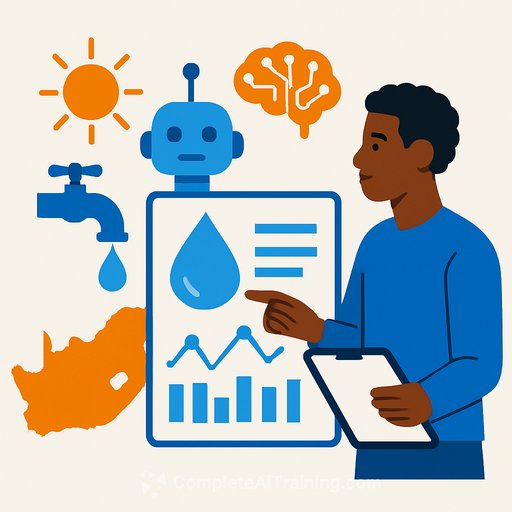
AI-powered water management R&D to strengthen water security in South Africa
Water security in South Africa is a management problem as much as it is an engineering one. Drought risk, aging networks, and budget pressure force teams to do more with less. AI gives utilities and municipalities a way to predict issues, cut losses, and plan investments with data they can trust.
Here's how to turn AI from a buzzword into measurable results across your water value chain.
Why this matters for management
- Reduce non-revenue water by finding leaks early and fixing the right pipes first.
- Stabilize service by forecasting demand, pump loads, and water quality events before they hit.
- Lower OPEX through targeted maintenance and smarter energy use at plants and pump stations.
- Defer CAPEX with asset life extension and pressure optimization instead of blanket replacements.
High-impact AI use cases to prioritise
- Leak and burst detection: Algorithms flag abnormal flows and pressures from smart meters and district metered areas, so crews roll out faster with fewer false alarms.
- Demand and supply forecasting: Time-series models predict zone-level consumption, reservoir levels, and pump schedules to cut energy peaks and avoid outages.
- Predictive maintenance: Condition and event data from pumps, valves, and treatment units indicate failure risk days or weeks in advance.
- Water quality monitoring: Sensors and lab data combined with anomaly detection help catch contamination trends early.
- Pressure optimization: Control strategies balance service levels and pipe stress, reducing bursts without hurting customers.
- Catchment and drought analytics: Satellite, rainfall, and dam data guide allocation decisions and restrictions with clearer trade-offs.
R&D building blocks for South Africa
- Data foundation: Standardise SCADA, AMI/smart meter, work orders, GIS, and lab results into a common data model. Start with one pilot zone to prove value.
- Sensors and connectivity: Expand smart meters and pressure loggers where losses are highest. Use low-power networks and solar to ride through power cuts.
- Model development: Apply proven methods (anomaly detection, time-series forecasting). Keep models simple enough for operators to trust and audit.
- Localisation: Train models on local climate and network patterns. Build bilingual alerts and operator workflows.
- Governance and cyber: Set clear data ownership, access controls, and incident response across IT and OT environments.
- Open standards: Require APIs and data export to avoid lock-in and support vendor competition.
Practical rollout plan
First 90 days
- Baseline: current non-revenue water, outage hours, energy per ML, water quality exceedances, and maintenance backlog.
- Pick one DMA and one plant for pilots. Instrument if needed (pressure, flow, vibration).
- Stand up a secure data pipeline from SCADA/AMI to a central analytics environment.
- Shortlist vendors and research partners. Finalise success metrics and a stage-gate plan.
Months 3-12
- Deploy leak detection and demand forecasting in the pilot area. Track work orders and fix times.
- Introduce predictive maintenance on critical pumps and clarifiers. Tie alerts to spare parts and crew schedules.
- Create an "analytics hub" function with one product owner, one data engineer, one analyst, and two operations champions.
Months 12-24
- Scale to additional DMAs and plants. Add pressure optimization and water quality anomaly detection.
- Integrate results into daily ops reviews and monthly board reports.
- Run a benefits audit and update the investment plan based on proven savings.
KPIs that prove value
- % non-revenue water and ML/day saved
- Average time to detect and repair leaks
- Forecast accuracy for demand and reservoir levels
- Energy kWh per ML treated/pumped
- Unplanned outage hours per 1,000 customers
- Water quality non-compliance events
- OPEX per ML and deferred CAPEX (documented)
Business case, simplified
Start with a clear formula: annual value = (recovered volume × tariff or avoided bulk cost) + (energy savings) + (avoided emergency repairs) + (deferred CAPEX value) - (program and data costs).
Even a 3-5 percentage point drop in losses in a single zone can fund the next two pilots. Keep benefits attributed to specific work orders and meter zones to avoid hand-waving.
Procurement and partnerships
- Outcome-based contracts: Tie fees to verified leakage reduction or energy savings, not software seats.
- Data terms: The utility keeps ownership. Vendors get time-bound, purpose-limited use rights.
- Security by design: Require third-party security testing and role-based access for all integrations.
- Local capacity: Pair vendors with South African universities or the CSIR for skills transfer and research continuity.
Risk controls that keep operations safe
- Run AI in "advisory mode" before closing any control loop. Human sign-off first.
- Set alert thresholds and escalation paths to avoid alarm fatigue.
- Refresh models on a fixed cadence and after major network changes.
- Separate OT networks, enforce least-privilege access, and log everything.
Team and governance
- Executive sponsor: Sets targets and clears blockers.
- Product owner (water ops): Owns backlog, KPIs, and adoption.
- Data engineer + analyst: Data pipelines and model monitoring.
- Field champions: Turn insights into work orders and verify outcomes.
- Steerco: Water, finance, IT/OT security, and supply chain meet monthly.
Policy and context
Align your roadmap with national priorities and regulatory standards. Useful starting points:
Upskill your team
Managers don't need to code, but they do need to set the right targets, structure pilots, and read model outputs with a critical eye. If you're building that capability internally, this resource can help:
Bottom line
Start small, measure hard, and scale what pays for itself. With a clear data foundation, the right partners, and disciplined governance, AI can help South Africa deliver reliable water service and better use every rand of investment.
Your membership also unlocks: