
AI news ·
South Korea commits $7.5 billion to AI manufacturing as smart factory count reaches 30,000
South Korea is investing $7.5 billion to expand AI automation in its manufacturing sector. The government will build over 100 AI production zones by 2030.
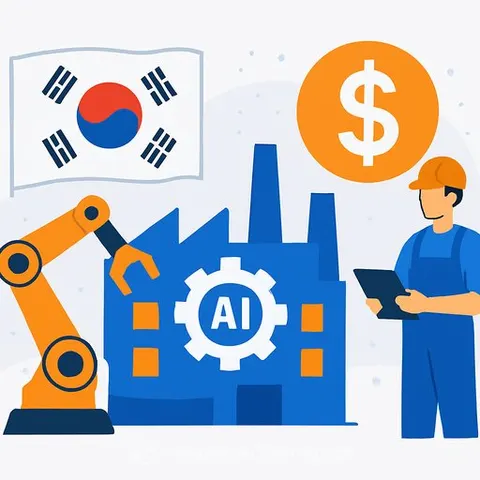
South Korea is investing $7.5 billion to accelerate AI-driven automation in its manufacturing sector, where 30,000 smart factories were already operational as of 2024, according to the U.S. International Trade Administration's Country Commercial Guide. The government plans to build more than 100 AI-based manufacturing zones by 2030, a move that will reshape supplier dynamics for procurement and trade agencies globally.
Manufacturing's central role in the Korean economy
Manufacturing contributed 24.3 percent of South Korea's GDP in 2024 and accounts for 90 percent of the country's exports. More than 80 percent of national R&D spending flows into manufacturing-related sectors, and the value added by Korean manufacturing reached $416 billion in 2023. That concentration makes smart factory policy a foundational piece of national infrastructure, not a standalone technology initiative. Shifts in automation strategy ripple through semiconductor, automotive, shipbuilding, and electronics supply chains worldwide.
The $7.5 billion AI manufacturing initiative
In September 2024, the Korean government introduced a financing initiative of up to $7.5 billion for its AI Autonomous Manufacturing Project. The program targets AI-based automation deployment across all manufacturing sectors, with a secondary goal of offsetting the country's declining working-age population. The ITA guide notes that Korea plans to build more than 100 AI-based manufacturing zones by 2030, concentrating on AI, robotics, and next-generation vehicles. A parallel $227 million public-private partnership was also announced in 2024 to help small and medium-sized enterprises adopt and scale automated technologies. More than 99 percent of Korean companies are SMEs, so this support channel matters as much as the headline AI program.
From centralized systems to modular automation
Korean conglomerates are shifting production environments away from legacy centralized control systems toward module-based, decentralized platforms with automated control layers. Advances in 5G, smart sensors, and nanomaterials are lowering implementation costs while raising performance floors. Smart factories increasingly rely on AI optimization engines and real-time monitoring through Industrial Internet of Things devices. Government-funded R&D testbeds are advancing capabilities in big data processing, cyber-physical systems, wireless networks, and collaborative robotics. The IIoT platform layer is a designated focus area under the government's published roadmap, alongside smart sensors, software-integrated operating techniques, and AI data processing. Understanding these policy shifts is part of broader AI for Government discussions on how national AI strategies reshape manufacturing sectors.
SME support structure and workforce training
Korea's Ministry of SMEs and Startups has formed Smart Manufacturing Innovation Centers under the Korea Technology and Information Promotion Agency for SMEs. These centers help smaller manufacturers access technology upgrades and smart manufacturing operations that would otherwise require capital and expertise beyond their reach. The government has also set a target to train 40,000 skilled workers to operate fully automated manufacturing sites through dedicated educational programs. The training target reflects a structural concern: Korea's working-age population is shrinking, and the long-term success of AI factory zones depends on having operators who can run them. That workforce constraint shapes the technology choices, favoring automation platforms that reduce reliance on manual intervention from day one.
Why this matters for government professionals
For trade and industrial policy teams, the $7.5 billion program signals a shift in Korean manufacturing that will affect global supply chains. Procurement officers should assess supplier readiness for AI integration, while export promotion agencies can identify opportunities in IIoT, AI software, and robotics as Korea builds out its 100 AI manufacturing zones. The ITA designates smart factory solutions as a leading export sector for U.S. firms, a topic that intersects with AI for Operations analysis on manufacturing supply chain automation. Evaluating supplier readiness for AI integration is a practical step that can inform trade policy and bilateral engagement with one of the world's most manufacturing-intensive economies.