South Korea Launches K-Moonshot to Deploy AI on Major Scientific Problems
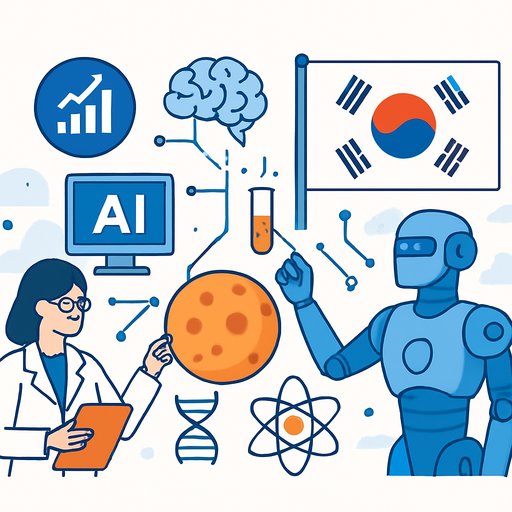
South Korea's Ministry of Science and ICT is launching K-Moonshot, a government-wide initiative to apply artificial intelligence to 12 major scientific and technological challenges by 2035. The ministry held a launch ceremony Thursday in Seoul and appointed 12 project directors to oversee the effort.
The goals are specific: double research productivity by 2030 and solve the 12 identified scientific problems by 2035. The K-Moonshot Promotion Group, led by Deputy Prime Minister and Minister of Science and ICT Bae Kyung-hoon, will oversee the project directors and coordinate policy and research funding across government ministries.
The 12 Missions and Directors
The appointed project directors bring experience from academia, research institutes, and industry:
- AI scientist: Lee Min-hyung (Astermov CEO)
- Humanoid robotics: Yeo Jun-gu (Daedong Robotics CEO)
- New drug development: Nam Jin-woo (Hanyang University)
- Brain-computer interfaces: Cho Il-joo (Korea University)
- Solar cells: Shin Hyun-jung (Sungkyunkwan University)
- Nuclear fusion: Yang Hyung-ryeol (Korea Institute of Fusion Energy)
- Small modular reactor vessels: Lee Dong-hyung (Korea Atomic Energy Research Institute)
- Physical AI: Kim Wook (Institute of Information & Communications Technology Planning & Evaluation)
- Space exploration: Lee Chun-woo (Korea Aerospace Research Institute)
- Advanced materials: Lee Sang-kwan (Korea Institute of Materials Science)
- Semiconductors: Kim Ji-young (Seoul National University)
- Quantum technology: Lee Soon-chil (KAIST)
Each director will manage the full lifecycle of their mission, from project discovery through commercialization.
Why This Matters for Researchers
K-Moonshot reflects a shift in how governments approach R&D. Rather than treating AI as a separate field, the project embeds it into existing scientific disciplines to accelerate progress on problems with direct national impact.
For research professionals, this signals increased funding and infrastructure investment in AI-driven research methods. The project also creates a model for how academic and government researchers can work with AI scientists and engineers on shared objectives.
Deputy Prime Minister Bae said the initiative aims to solve problems facing humanity, not simply integrate AI into science and technology for technical advancement alone.
Learn more about AI for Science & Research and AI Research Courses to understand how these tools apply to your field.
Your membership also unlocks: