
AI news ·
South Korea launches AI legal secretary for public officials
South Korea launches an AI Legal Secretary for public officials on July 14. The in-house tool uses 240,000 statutes and 60,000 precedents to speed up legal reviews.
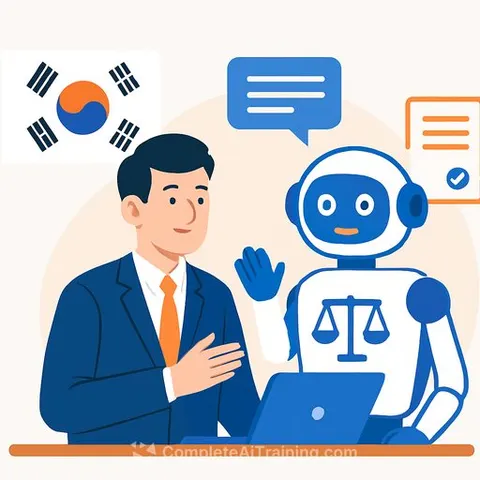
South Korea's government will roll out a generative AI service on July 14 that answers legal questions from public officials handling administrative work. The tool, called AI Legal Secretary, was trained on 240,000 statutes, administrative rules, and local ordinances, plus 60,000 Supreme Court precedents, and is designed to cut the time officials spend on legal interpretation.
What the AI Legal Secretary does
The service lives on the administrative internal network accessible to public officials. When a user asks a legal question related to their duties, the system draws on its training data to produce an answer. To reduce hallucinations-where AI generates plausible but incorrect information-the tool uses Retrieval-Augmented Generation (RAG), which anchors responses to the source material it has ingested.
The Ministry of Government Legislation was clear about the tool's limits. It cannot replace legal judgment and is meant only as interim review material. The three ministries behind the project-Government Legislation, the Interior and Safety, and Science and ICT-developed it entirely in-house, without outsourcing, in one month.
Built on a domestic AI foundation
The ministry credited the fast turnaround to existing government-wide AI infrastructure. "The government-wide AI common foundation already had implemented legal information retrieval-augmented generation, and the Ministry of Government Legislation had established a professional workflow for legal drafting and interpretation," the ministry said in its self-assessment. The system runs on a Korean foundation model rather than foreign alternatives.
Deputy Prime Minister Bae Kyung-hoon, who also serves as Minister of Science and ICT, said, "This initiative is significant as it applies our independent AI foundation model to administrative settings. We will continue strengthening our autonomous AI capabilities and expand their use across public and private sectors to solidify the national AI ecosystem."
Efficiency gains and the push for AI-driven government
Cho Won-cheol, Minister of Government Legislation, pointed to the difficulty public officials face when interpreting laws. "Legal interpretation and enforcement require high expertise, making it one of the most challenging tasks for public officials. With the AI Legal Secretary, their work efficiency will improve dramatically. The time saved by public officials through AI will be used to serve the people," he said.
The Interior and Safety Minister, Yun Ho-jung, framed the launch as the first step toward a broader transformation. "The AI Legal Secretary service is the first example demonstrating the new possibilities of an 'AI Democratic Government' through public AI transformation. We will spread this innovation-where all public officials develop and use AI services tailored to their work-across the entire government," Yun said. This aligns with a growing push to embed AI for Government workflows, though the Korean model emphasizes tools built by civil servants themselves.
Why this matters for government professionals
The AI Legal Secretary is not a legal decision-maker. It's a research accelerator. For public officials who spend hours cross-referencing statutes, ordinances, and court rulings, a tool that surfaces relevant authorities in seconds changes how that time gets allocated. The fact that it was built internally-without external vendors-also signals that agencies may increasingly expect staff to participate in developing and refining AI for Legal tasks. Officials who understand how these tools work, where they fail, and how to verify their outputs will be positioned to use them effectively as the government expands the program across departments.