
AI news ·
South Korea warns tech giants that AI profits must be shared broadly as Samsung faces historic labor unrest
South Korea's government warned tech giants to share AI profits with workers or face regulation. The threat comes as Samsung posts record AI chip earnings while managing its worst labor unrest in decades.
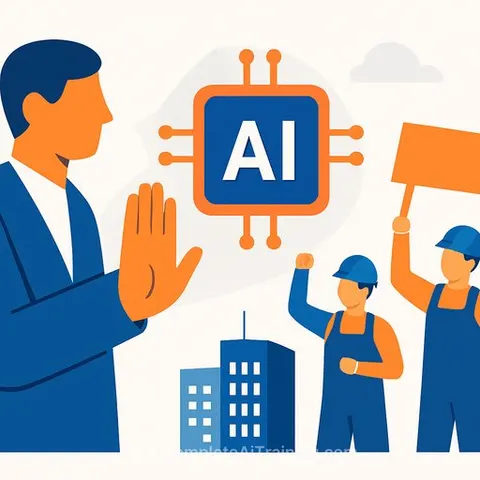
South Korea Warns Tech Giants: Share AI Wealth or Face Regulation
South Korea's Deputy Prime Minister Kim Byoung-hwan told CNBC the government won't tolerate artificial intelligence widening the gap between tech companies and workers. The warning carries immediate weight: Samsung, the world's largest memory chip maker, is managing its worst labor unrest in decades while posting record profits from AI chip sales.
"There are concerns as to whether AI could worsen wealth gaps or lead to job losses," Kim said, signaling this is now a matter of national economic policy.
The Samsung Test Case
Samsung's semiconductor division generated operating profits exceeding $20 billion in the past fiscal year, driven largely by high-bandwidth memory chips essential for AI training. The National Samsung Electronics Union has been demanding wage increases and clearer profit-sharing arrangements tied to AI revenue.
The timing exposes a central tension: AI is minting billions for manufacturers while workers worry about automation replacing their roles.
Why Seoul's Position Matters
South Korea controls roughly 70% of global memory chip production that powers AI data centers through Samsung and SK Hynix. That position gives the government unusual leverage to shape how AI's economic gains get distributed.
Rather than focusing on safety or ethics alone, Seoul is targeting distributive outcomes-asking whether technological advancement serves broad prosperity or concentrates wealth among capital holders. This approach could become a template for policy across Asia.
A Pattern Across Industries
Global labor movements are already mobilizing around AI concerns. Hollywood writers and actors struck over AI usage rights. European unions are pushing for stronger protections against algorithmic management. South Korea's government appears to be establishing expectations now, before AI deployment accelerates across manufacturing and services.
The country has historical precedent for this kind of intervention. During rapid industrialization, South Korea's government applied strong guidance over corporate affairs, particularly around labor and economic equity. Officials have shown willingness to pressure major conglomerates when public interest demands it.
What Companies Should Expect
For tech companies operating in South Korea, the message is direct: AI profits come with social obligations. Whether that becomes regulatory requirements for profit-sharing, stricter labor protections, or new taxation schemes remains unclear.
Other major Korean tech players-LG, SK Hynix, Naver-are watching Samsung's labor negotiations closely. How the company resolves its disputes and whether it implements meaningful profit-sharing tied to AI revenue could shape government policy for the entire sector.
The Speed Problem
Previous technological shifts played out over decades, giving societies time to adapt. AI is compressing those timelines. Trillion-dollar valuations and massive productivity gains are happening within just a few years.
Governments like South Korea's recognize they can't afford to wait a generation to address distributional consequences. How societies allocate AI-generated wealth will determine whether this technology creates broad prosperity or entrenches existing inequalities.
Seoul is signaling it won't leave that outcome to chance. Other governments are likely watching to see whether intervention works. For tech giants counting on AI to drive their next growth phase, the message is unmistakable: prepare to share the gains, or regulators will find ways to redistribute them.
Learn more about AI for Government or explore the AI Learning Path for Policy Makers to understand how these policy decisions are shaping the future of technology regulation.