
AI news ·
South Korean startup films hotel and warehouse workers to build AI training data for robots
South Korean startup RLWRLD is filming hotel and warehouse workers to build a motion database for training robots. The company aims to deploy AI-controlled robots across factories by 2028, with homes to follow.
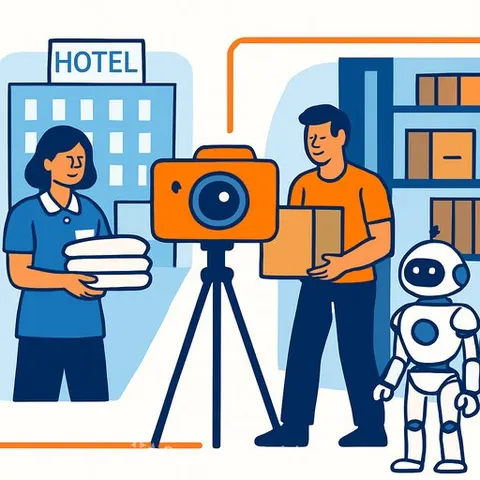
South Korean startup trains robots by capturing workers' precise movements
David Park stands in a banquet hall at Seoul's Lotte Hotel with body cameras strapped to his head, chest, and hands. He folds napkins and polishes silverware the same way he has for nine years. Every motion feeds into a database destined to teach robots the same tasks.
Park is one of roughly 10 hotel workers helping RLWRLD, a South Korean AI startup, build what amounts to a library of human expertise. The company is collecting similar data from warehouse workers at logistics firm CJ and staff at Lawson convenience stores in Japan, capturing how they grip objects, lift goods, and arrange displays.
The goal is to create an AI software layer that can control robots across factories and work sites by 2028, with potential expansion into homes. RLWRLD unveiled its robotics foundation model last week-an AI system designed specifically for robots rather than text-based tasks.
Why South Korea sees an advantage
South Korean firms are competing in the global "physical AI" market, where machines equipped with AI and sensors perceive and act in real environments. U.S. companies like Tesla and Chinese firms are pouring billions into humanoid robots, but South Korea believes it has an edge.
Just as chatbots train on vast amounts of text, robots need extensive data on human movement to master complex physical tasks. South Korea's deep manufacturing sector and skilled workforce provide that training material. The government last month announced a $33 million project to capture the "instinctive know-how and skills" of master technicians into a database for AI-powered manufacturing.
Billy Choi, a professor at Korea University's center for Human-Inspired AI Research, said the focus is "squarely on humanoids tailored specifically for those industries."
The technical challenge: learning dexterity
RLWRLD's process involves multiple layers. Engineers first convert worker footage into machine-readable data. They then repeat those tasks while wearing cameras, VR headsets, and motion-tracking gloves. This captures fine details like joint angles and force applied.
The company is developing five-fingered hands that mimic human touch, unlike most industrial robots that use task-specific grippers with two or three fingers. While five-fingered designs may not suit every factory task, they could prove essential as robots move into homes where they'll interact more closely with people.
Hyemin Cho, who handles business strategy at RLWRLD, said hand dexterity will determine whether humanoids can work in diverse industrial settings and homes. "Capturing motion data in real-world settings is extremely important and the quality of that data matters greatly," she said.
Timeline and deployment plans
Hyundai Motor plans to introduce humanoids built by its robotics unit, Boston Dynamics, at its Georgia plant in 2028. Samsung Electronics aims to convert all manufacturing sites into "AI-driven factories" by 2030, with humanoids and task-specific robots across production lines.
Lotte Hotel expects robots to handle cleaning and other behind-the-scenes tasks by 2029, though current systems would need several hours to clean a guest room that humans finish in about 40 minutes. The hotel estimates robots could eventually take over 30% to 40% of back-of-house work, with the remaining tasks requiring human-to-human interaction.
Labor concerns mount
South Korea's AI push has unsettled unions, who worry robots could eliminate jobs and erode the skilled workforce that forms the nation's competitive advantage-the very asset being leveraged for AI development.
After Hyundai's union warned in January that robots could trigger an "employment shock," President Lee Jae Myung described AI as an unstoppable "massive cart" and called for workers to adapt to changes "coming faster than expected."
Kim Seok, policy director at the Korean Confederation of Trade Unions, argued that widespread robot deployments risk "severing the pipeline" for skilled labor. He urged the government and employers to engage workers over AI to ease job concerns, noting that "mastery of skills is ultimately a human achievement - even if AI can replicate existing abilities, the continuous development of craft will remain fundamentally human."
Learn more about AI for IT & Development and Generative AI and LLM systems that power these robotic applications.