
AI news ·
Special Operations commander insists humans must retain control over AI targeting decisions
U.S. Special Operations Command chief Adm. Frank Bradley says humans must always make the call on lethal force, even as AI targets enemies. He compared AI targeting to a sling-the user must trust it hits only the intended mark.
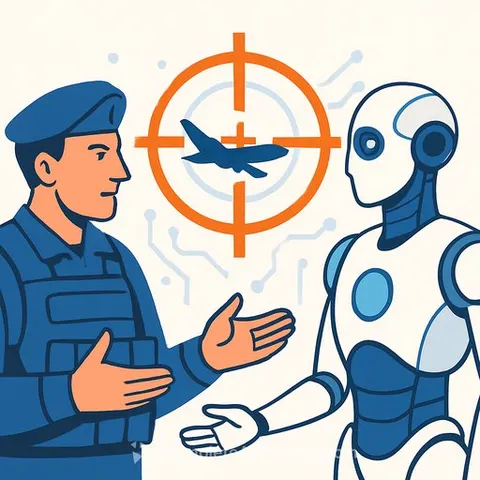
Special Operations Chief Insists Humans Must Decide When to Use Force
Navy Adm. Frank M. Bradley, commander of U.S. Special Operations Command, said Tuesday that humans must retain control over lethal decisions, even as the military deploys artificial intelligence systems to identify targets.
"There will always be a human in the loop of that delivery of violence," Bradley said at SOF Week in Tampa, Florida. "The human that decides to use lethal violence has to have the trust and confidence that that lethal violence will be delivered within the confines of that contract, established internationally, as a law of armed conflict."
Bradley used a historical analogy to frame the issue. He compared AI targeting systems to a soldier throwing a stone from a sling-the person must have confidence the weapon will hit the intended target and only the intended target.
Military Testing Before Deployment
Bradley said Special Operations Command tests AI tools before deployment to ensure they meet command requirements. The command does not place computers in positions to order or execute lethal actions, he said.
"We, as humans, have that confidence that the delivery mechanism is going to behave as we intended it to behave," Bradley said. "It's going to deliver violence only to where we intended it to be delivered."
Real-World Complications
The tension between automation and human control is not theoretical. In 2020, the Joint Special Operations Task Force-Afghanistan deployed an AI system called Raven Sentry that predicted insurgent attacks using satellite imagery, news reports, and social media data.
Recent reporting has raised questions about how these systems work in practice. The Los Angeles Times documented an Israeli AI-powered targeting system that tracked a 62-year-old man in Lebanon who had once been a Hezbollah fighter but was working in an administrative role rebuilding a village. A drone strike, overseen by human operators, killed him outside his family home.
Defense Secretary Pete Hegseth has also publicly disputed with Anthropic, a major AI developer, over safeguards around surveillance systems.
A Decades-Old Concern
The principle Bradley described-that humans must remain accountable for lethal decisions-is not new. IBM employee manuals from 1979 stated: "a computer can never be held accountable, therefore a computer must never make a management decision."
Bradley acknowledged that AI is making military operations more efficient. But he said the command must verify that systems perform as intended before they reach the battlefield.
For operations professionals managing these systems, understanding the control frameworks around AI is critical. The AI Learning Path for Operations Managers covers how to evaluate automation tools and maintain human oversight in critical processes.