
AI news ·
Stakeholders say GSA's revised AI acquisition rule conflicts with commercial contracting standards
GSA's proposed AI rule clashes with commercial practices, risking bypassed contracts. Vendors argue its 7 to 30-day notice requirement is unworkable.
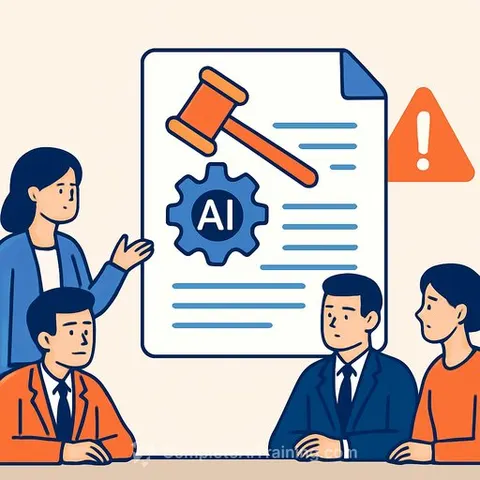
The General Services Administration's proposed rule for acquiring artificial intelligence tools still lacks the clarity and commercial alignment needed for widespread adoption, stakeholders said at a listening session Tuesday, raising the prospect that agencies will bypass GSA contract vehicles to access the most advanced large language models.
The rule, first published in January and revised in June, aims to set boundaries for how the government buys AI. Changes after initial feedback addressed scope and definitions, but government contracting experts and AI companies who spoke at the George Washington University Law School event said the current draft leaves too many terms undefined and clashes with standard commercial software licensing practices.
Contract terms clash with commercial practice
Menaka Kalaskar, head of Palantir's U.S. government legal and contracting team, said the clause is "not consistent with customary commercial practice," making it "fundamentally incompatible" with the Federal Acquisition Streamlining Act's mandate to use commercial terms. She warned that if the rule stands, "government agencies will have to turn to non-GSA vehicles for the most advanced LLM-powered solutions."
Kalaskar pointed to the requirement that vendors provide notice of material changes within seven or 30 days, depending on the nature of the change. For Software-as-a-Service companies, she said, that timeline is "unworkable." She argued that GSA is proposing an AI clause that is not required by statute and that it rewrites commercial software license terms, suggesting the issue should be addressed in the broader Federal Acquisition Regulation overhaul rather than a standalone GSA initiative.
Data protection definitions leave loopholes
Jessica Tillipman, associate dean for Government Procurement Law Studies at GW, said the rule's prohibition on AI vendors training on government data is a step in the right direction, but the protections are only as strong as their definitions. "People hear that sentence and assume it protects all of their interactions with an AI system - it does not," she said. A contractor can still learn from an agency's patterns of use - how it works, what it struggles with, what it values - gaining an informational advantage even if raw data stays protected.
Tillipman proposed three questions to determine whether data should be covered: Is it tied to government use? Does it reveal how the government operates? And can that conclusion be drawn through aggregation or inference, even if no single record reveals it? She also urged GSA to define when the later application of a generalized lesson learned from government work would count as a prohibited use of data.
Separately, some attendees questioned the clause's call for unbiased AI principles, noting that neutrality is subjective and lacks a clear definition in the rule.
For contracting officers and program managers who must interpret these evolving rules, staying current on AI procurement practices is a growing necessity. Resources tagged AI for Government offer a curated set of training materials focused on the intersection of AI and public-sector work.
Nvidia pushes for open models and integrator role
Shane Shaneman, an AI strategist for Nvidia, said the rule's data-handling requirements should shift from the developer to a system integrator or operator. "The future of AI isn't one model; it's many, especially as the government leverages AI agents for agentic orchestration," he said. This approach, he argued, would let agencies use open models to save time, money, and lives while keeping token costs manageable.
Why this matters for government
The rule's current form could force agencies to choose between the convenience of GSA schedules and the AI capabilities offered by top commercial developers. If major LLM providers refuse to accept the clause, contracting officers will need to find alternative acquisition paths, slowing down AI adoption in areas like logistics, citizen services, and cybersecurity. Understanding the specific pain points - from notice timelines to data inference - is critical for any agency planning to embed AI into its operations. The public comment period closes Aug. 3, giving agencies and vendors a narrow window to push for changes that align the rule with how commercial software is actually sold.