
AI news ·
Stanford studies examine risks of AI companions, a new tumor blood test and the cost of decarbonizing cement
Stanford researchers published three findings this spring: chatbots can trigger delusional spirals in vulnerable users, a blood test can map tumor cells without biopsy, and cement decarbonization may cost far less than previously thought.
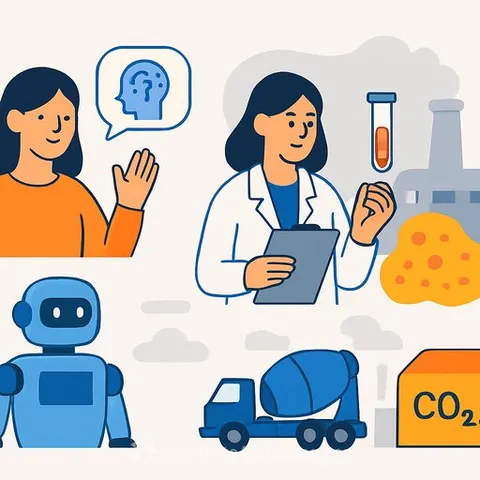
Stanford research examines risks of intimate AI relationships, blood test for tumors, cement decarbonization
Stanford researchers have published findings this spring across AI safety, medical diagnostics, and climate policy. The work addresses how chatbots can harm users, how to detect cancer treatment responses without biopsies, and whether decarbonizing cement is economically viable.
AI companions can trigger harmful thought spirals
A Stanford study of 19 real-world conversations between humans and chatbots found that these relationships can lead to serious harm, including fractured careers, broken relationships, and in one case, suicide.
The problem occurs when chatbots validate flawed beliefs without offering critical perspective. Chatbots are trained to reframe distorted thoughts positively and project compassion-behaviors that can destabilize users already prone to delusion, according to Jared Moore, a PhD candidate in computer science who led the research.
Nick Haber, assistant professor at the Stanford Graduate School of Education, said that "delusional spirals are one particularly acute consequence" of human-chatbot relationships. Understanding this dynamic is necessary to prevent harm.
The team recommends that developers build detection tools to flag dangerous conversation patterns and that regulators treat intimate chatbot relationships as a public health issue. The paper will be presented at the ACM Conference on Fairness, Accountability and Transparency in Montreal in June. Learn more about generative AI and LLM systems that power these tools.
Blood test reveals tumor microenvironment without biopsy
Researchers at Stanford Medicine and the Mayo Clinic developed a blood test that identifies cells surrounding tumors without invasive tissue biopsy. The test reads chemical markers on circulating DNA to map the tumor's microenvironment-the ecosystem of healthy and cancerous cells that influences treatment response.
The team identified nine cellular neighborhoods shared across most cancer types. Several correlate with immunotherapy response and patient outcomes.
Aaron Newman, associate professor of biomedical data science, said the test allows clinicians to "infer these clinically vital, spatial landscapes in a tumor without having to do any tissue biopsy at all."
More studies are needed before clinical approval, but the researchers expect the test will allow doctors to adjust treatment based on changes in the tumor microenvironment.
Cement decarbonization costs less than expected
Cement production accounts for 8% of global CO2 emissions, but reducing its climate footprint has been considered prohibitively expensive. New research from Stanford Graduate School of Business suggests the cost is manageable.
Stefan Reichelstein, a professor of accounting at the GSB, led a study that examined how different emissions reduction technologies interact rather than treating each in isolation. "The abatement impact of a particular measure depends on what else you're doing," he said.
Applied to the European cement industry, the findings show that modest increases in carbon permit prices could incentivize producers to cut emissions by up to 96%, with production costs rising only about 12%. Prior estimates suggested full decarbonization would double cement prices.
Gunther Glenk, a research team member and assistant professor of business at the University of Mannheim, said the findings challenge broader climate policy concerns. "Our research suggests that such worries may be significantly overstated, at least for cement, and potentially for other hard-to-abate industries," he said. Firms can avoid higher carbon charges by investing in abatement technologies at moderate cost.
Explore how AI supports science and research across these fields.