
AI news ·
Starbucks adds ChatGPT integration to help customers find drinks through natural language
Starbucks launched a ChatGPT tool that recommends drinks based on a customer's mood or craving, sitting between browsing and ordering. All transactions route back through Starbucks' own app, keeping order and customer data in-house.
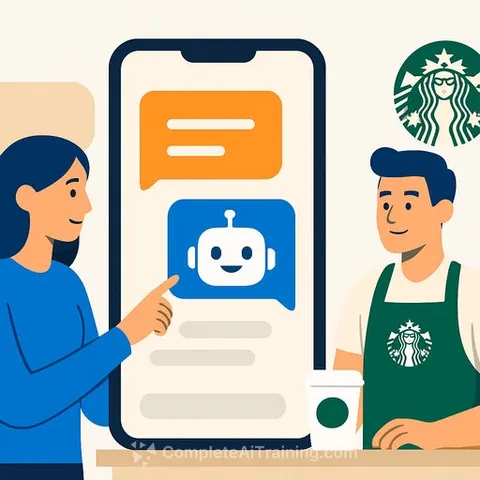
Starbucks Tests Conversational AI for Drink Selection, Signaling Shift in Restaurant Discovery
Starbucks launched a ChatGPT integration this week that lets customers describe a mood or craving and receive tailored drink recommendations. The feature sits between browsing and ordering, functioning as a discovery layer rather than replacing existing ordering systems.
This positioning reflects a deliberate choice. Instead of automating the transaction itself, Starbucks is automating the decision-making phase that precedes it-the part of the customer journey that has remained largely unchanged for years.
Why Discovery Matters for Operations
Starbucks operates one of the most complex beverage platforms in the industry. Thousands of customization combinations and seasonal variations create friction for customers who are unsure what to order. A conversational interface can reduce that friction by narrowing choices without removing them.
The company mitigates control concerns by routing all transactions back into its own app and website. Starbucks preserves ownership of the order and customer data, even though the recommendation happens on a third-party platform.
How This Differs From Drive-Thru AI
The restaurant industry has tested voice AI in drive-thrus, but with mixed results. Those systems operate within tight constraints-translating spoken input into structured orders with the goal of speed and consistency. Success has been uneven, with struggles around edge cases and variable customer speech patterns.
Starbucks' approach is more forgiving. It uses open-ended conversation but applies it to a bounded problem. If a recommendation misses the mark, the user simply adjusts it. The cost of being slightly off is low.
Broader Applications Across the Industry
The underlying concept extends beyond beverages. Fast-casual chains could use similar approaches to guide customers through build-your-own menus, helping them assemble meals based on dietary preferences or time of day. Full-service restaurants could offer dish suggestions based on occasion or prior visits. Quick-service chains could experiment with guided recommendations in mobile apps during off-peak browsing.
The common requirement across all these cases is the same: recommendations must reflect what can actually be executed consistently in-store. Without alignment between what the AI suggests and what operations can deliver, the value disappears quickly.
What Operators Need to Know
For operations teams, this test signals where large language models are proving useful and where they are not. They work well as discovery tools that sit upstream of existing workflows. They struggle when asked to operate within rigid constraints or handle high variability.
The boundary between browsing, deciding, and ordering is becoming less rigid. The question for operators is not whether that boundary will shift, but how quickly and in which parts of the experience it will matter most.
If your organization is considering similar implementations, the AI Learning Path for Operations Managers covers practical decision-making around AI adoption, including how to evaluate use cases and align them with operational constraints.