
AI news ·
Startup uses paper and pencil to teach AI to young students
Overture Games teaches AI to elementary students across 54 schools using a paper-and-pencil method. Instructors run the software while kids write prompts by hand.
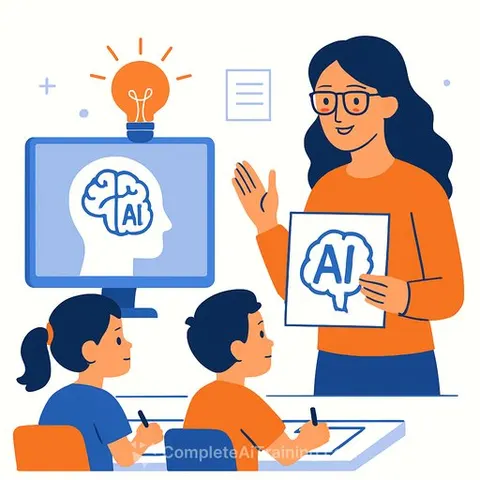
At the Rebecca K. Crown Chicago Youth Center in South Shore, 8-year-old Matthew Uriosdegui handwrote lyrics and instrument choices for a rap celebrating the last day of his after-school program. His instructor then typed those notes into an AI music generator, and within minutes, Matthew was snapping along to a computer-produced track. This pencil-and-paper workflow is the signature of Overture Games, a startup that now delivers AI classes to 54 schools and youth centers across Illinois and Massachusetts, aiming to teach foundational AI skills to children as young as second grade without putting them directly in front of the tools.
Overture was founded by two recent Northwestern University graduates who pivoted from music education to AI instruction as they saw schools struggling to introduce the technology. "You could feel this sense of huge fear and anti-innovation approach coming from the school, not because they don't think it's a great technology, but because they don't know how to introduce it to the students," said cofounder Steven Jiang. Their model lets instructors be the sole operators of AI platforms like Google Gemini and Runway AI, while students brainstorm, draw characters, and write prompts by hand.
A split among experts on what young children really need to learn
The program arrives as many elementary schools lag behind older grades in AI use. A 2025 RAND Corporation report found that only 42% of elementary teachers had ever introduced AI in the classroom, compared to more than 60% of middle and high school teachers. Limited research exists on best practices for the youngest learners, and experts disagree on what skills to prioritize.
Victor Lee, an education professor at Stanford University who helps high school teachers incorporate AI, questions whether prompting is the right focus. "The question we have to ask is: Is prompting the most important skill to learn? I would say a lot of AI literacy experts say no," he said. Lee believes conversations about AI's limitations-something Overture also covers-are more valuable than having elementary students actually use the tools.
Others, like Elizabeth Radday of EdAdvance, a Connecticut education nonprofit, argue that hands-on creation helps children retain information. "There's a big difference between kids that are doing things to create a final project, versus clicking through something and just watching videos," Radday said. Overture's 10-week courses culminate in a student-designed interactive game or imaginary world, built step by step with AI assistance controlled by the instructor.
Paper-and-pencil approach appeals to schools and parents, with caveats
At a time when some districts are hungry for age-appropriate AI guidance, Overture's method has gained traction. Many educators looking at AI for Education resources see the program's limited screen time as a safety feature. Of the 38 schools Overture partners with in Illinois and Massachusetts, 27 are private schools, though the company is expanding its public school clients. Grant-funded classes are free at some Chicago Youth Centers, but typical parent-paid pricing runs about $300 for a 10-week course.
Parents like Alice Raflores, whose second grader attends Longfellow Elementary in Buffalo Grove, signed up because the classes required handwriting and adult-controlled AI access. "I see it as teaching him that there are tools out there that can assist him in doing other things, but it is one tool of many," Raflores said. Yet she and other parents noticed a paradox: after class, children often begged for more screen time to experiment with AI on their own. "The moment he comes home from those classes, he's like: 'I want to do AI, I want to build something,'" Raflores said. "I have to encourage him to not start there."
The program's "Real or AI" game, where students guess whether images are real or computer-generated, has proven popular. Matthew learned to spot missing music notes and overdone lighting in AI images. "Sometimes AI makes mistakes," he said. "It's just a tool." But when asked later what AI is, he and many classmates could only describe it as "fake" or "not real"-a reminder that hands-on use doesn't always translate to conceptual understanding.
Unequal access pushes after-school programs to fill gaps
RAND's research also showed steep disparities in teacher training: 43% of low-poverty districts had trained teachers on AI, while only 6% of high-poverty districts had done the same. That gap is why Chicago Youth Centers sought out Overture. Devin Swift, who manages science and technology programming, said the question is not whether students should learn about AI, but how to ensure access for Black and Brown youth from under-resourced communities. "So that when they get out into the world, they have all the tools necessary to be good adults, to be in the workforce," Swift said.
For elementary school teachers and administrators, the emergence of formal programs like Overture's comes at a moment when many lack district-provided training. A growing number are seeking AI Learning Path for Primary School Teachers materials to build their own fluency before introducing the technology in class.
Why this matters for education professionals
Overture's expansion signals that demand for early AI instruction is real, but the field is still without consensus on what effective instruction looks like. Teachers and administrators must decide whether programs should emphasize hands-on creation, critical evaluation of AI output, or both-and how to do so equitably. The program's paper-and-pencil model shows that restricting direct tool access can ease safety concerns, yet the gap between using AI and truly understanding it remains a challenge for young learners. As schools consider adding AI to the curriculum, the lack of research and uneven access mean education professionals will need to weigh carefully whether such programs align with core learning goals or simply respond to market enthusiasm.