AI for Support: Why Full Resolution Beats Deflection at Scale
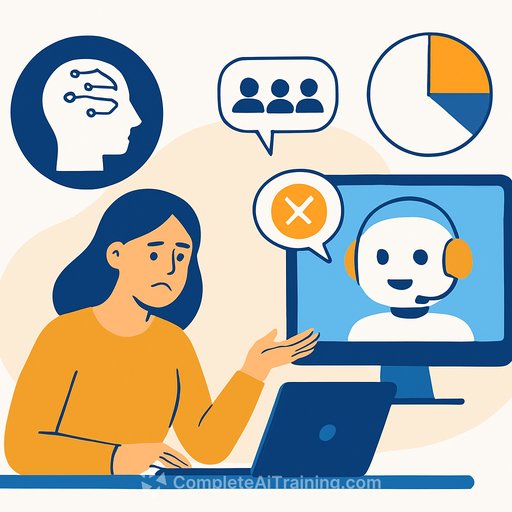
Most AI in support is built to deflect. Route the ticket. Suggest an article. Add another step. That might help in the short term, but at high volume it turns into a queue of half-solved issues and frustrated customers.
A recent post from Maven AGI makes a simple argument: the only scalable model is end-to-end resolution. If an assistant can actually fix the issue, close the loop, and do it fast - your team wins capacity, your customers get certainty, and your backlog stops snowballing.
The problem with deflection-first tools
- They push effort back on the customer and the agent.
- They look efficient on dashboards, but hide unresolved work.
- As volume spikes, deflection layers compound delays instead of clearing the queue.
Deflection isn't bad; it's just incomplete. It should be the exception, not the strategy.
Resolution-first: what it actually means
- Automate the full workflow, not just the response: authenticate, fetch data, update systems, issue refunds/credits, trigger replacements, close the ticket.
- Guarantee clean handoff when automation can't finish - complete context, action history, and next-best steps for the agent.
- Measure on resolved outcomes, not containment.
What the numbers suggest
Maven AGI cites two datapoints from customers:
- Thumbtack: more than 15% improvement in customer satisfaction compared with 50 other vendors.
- K1X, Inc.: tenfold increase in tickets resolved in a week.
Methodology isn't detailed, so treat these as directional. Still, the pattern lines up with what most teams see: resolution beats deflection on customer satisfaction and throughput.
Why this matters for support leaders
- Higher effective capacity without headcount bloat.
- More predictable service levels when demand jumps "100x."
- Cleaner ops: fewer reopen rates, fewer escalations, tighter loop between support and product.
What to measure (and hold vendors to)
- End-to-end resolution rate: Percentage of total tickets fully solved by automation.
- Time to resolution: Median and P95 for automated vs. human-handled cases.
- CSAT/Customer sentiment: Post-resolution ratings, not just chatbot thumbs-up. See fundamentals here: CSAT basics.
- Reopen rate: Issues reopened within 7-14 days after "resolution."
- Handoff quality: Cases escalated with complete context, actions taken, and proposed next steps.
Designing for a 100x spike
- Automation-first workflows: Map top intents to full actions across CRM, billing, order management, and policy checks.
- Rate limits and prioritization: Protect upstream systems; prioritize high-value or time-sensitive intents.
- Knowledge freshness: Auto-sync policy and product changes; expire stale content.
- Guardrails and approvals: Thresholds for refunds/credits, with instant agent approval paths.
- Observability: Traces, outcomes, and feedback loops to fix failure modes fast.
For practical guidance on structuring these workflows and trade-offs, see Design.
Questions to vet any AI support vendor
- What percentage of tickets are fully resolved, end-to-end, without agent touch?
- Which back-office actions can your system perform today (refunds, replacements, cancellations, account updates)?
- How do you handle partial resolutions and escalations? Show the handoff artifact.
- What are your P95 resolution times under load, and how do you fail safely?
- How do you detect and reduce reopens and negative sentiment after automation?
The investor angle (short and relevant)
If a platform consistently improves resolution rates and customer satisfaction, it gains pricing power and stickiness. That's why the market is shifting its attention from chatbot containment to full-ticket outcomes.
Takeaway for support teams
Deflection helps, but resolution compounds. Build or buy systems that finish the job, instrument them with the right metrics, and prepare your workflows for surge demand before it hits.
If you're upskilling your team on practical AI for support ops, this curated resource can help: AI courses by job.
Your membership also unlocks: