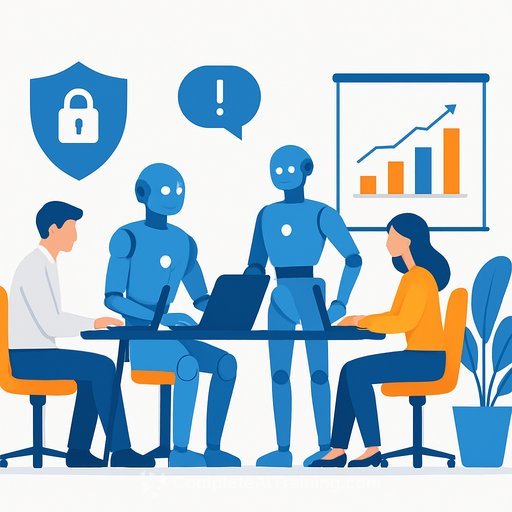
Without a data foundation, AI remains a placebo
Finance leaders are carrying a wider load-investments, supply chains, compliance, and the digital agenda. Many feel the weight. The bigger issue isn't effort; it's data. Fragmented, legacy ERP setups block a clear, consistent view across the business. Finance leaders who need a structured program to align strategy and data can refer to the AI Learning Path for CFOs.
The result: planning turns reactive, consolidation gets pricey, and reporting errors sneak in. If you're asking AI to fix this without fixing data first, you're asking for noise at scale.
Forecasting fails without unified data
Most finance teams say precise forecasting is still a major challenge. It's not a modeling problem-it's a data problem. Without one high-quality source of truth, your forecasts will mirror inconsistency. Finance managers implementing AI-driven forecasting and FP&A improvements should see the AI Learning Path for Finance Managers for practical guidance.
The first lever is system integration. A central, quality-assured data architecture lays the groundwork for real-time analysis, scenario simulation, and reliable forecasts.
Integrated platforms beat point solutions
AI-supported platforms can automate data extraction, accelerate reporting, and detect anomalies. They also trim manual effort where it hurts most.
Stand-alone tools bring short-term wins, but they often add interface overhead, duplicate data, and hidden maintenance costs. Integrated platforms standardize processes across the stack, improve security, and give finance clean visibility into critical KPIs.
What "integrated" actually means
- Unified master data and shared business definitions across entities
- Near real-time data pipelines with lineage and quality checks
- Standardized workflows spanning order-to-cash and source-to-pay
- Clear ownership: governance, role rights, and audit-ready controls
Teams responsible for O2C and S2P implementation patterns can draw practical approaches from the AI Learning Path for Supply Chain Managers.
Liquidity is the backbone-treat it like one
Delayed payments, weak order-to-cash, and opaque source-to-pay push up DSO, erode discount capture, and lock up capital. That's why working capital sits at the top of the CFO agenda.
AI improves payment and risk predictions. Automated workflows speed up receivables and payables, cut errors, and give you steadier cash visibility.
Quick wins for cash flow and working capital
- Clean customer and vendor master data; standardize credit terms
- Automate invoice capture, matching, and dispute workflows
- Score customers for risk and prioritize collections with AI
- Introduce payment plans and dunning cadences based on predicted behavior
- Measure DSO, on-time payments, discount capture, and cash conversion cycle weekly
From firefighting to prevention in risk and compliance
Cybersecurity, ESG, compliance, geopolitics-reactive work drains time and weakens your position. AI helps you see issues early and act with context.
- Anomaly detection in ordering and invoicing to flag leakage and fraud
- Transaction risk scoring and automated holds for policy breaches
- Digital assistants surfacing real-time insights for audits and controls
Anchor your approach to proven frameworks like the NIST Cybersecurity Framework and extend controls across your finance tech stack.
Agentic AI: autonomous sub-processes, not magic
Agentic AI will take on well-bounded sub-processes, pull from multiple systems, and deliver context to decision-makers. The real benefit comes from orchestration: data quality, clear rules, role rights, and a learning KPI set.
Do that, and you get faster, well-grounded decisions, broader transparency, and efficiency gains-without adding headcount.
How to start with Agentic AI
- Pick a stable, rules-heavy process (e.g., invoice exception handling or cash application)
- Define policies, thresholds, handoffs, and human-in-the-loop moments
- Simulate on historical data, then deploy in stages with tight monitoring
The order of operations that works
- Phase 1 (0-120 days): Data clean-up, master data alignment, integration of core finance systems, baseline dashboards for working capital and forecast accuracy
- Phase 2 (6-12 months): Consolidate onto an integrated platform; automate AP/AR workflows; enable near real-time cash and risk views
- Phase 3 (12+ months): Introduce agentic capabilities across O2C, S2P, and FP&A; expand anomaly detection and policy automation
KPIs that keep you honest
- Forecast accuracy by horizon (30/60/90 days)
- DSO, DPO, and cash conversion cycle
- % touchless invoices (AP and AR)
- Close cycle time and consolidation cost per entity
- Data freshness SLA and data quality score (completeness, consistency, timeliness)
- Control effectiveness: audit findings, policy breaches, fraud incidents detected vs. missed
Practical next steps
- Map your current finance data flows; document the sources of truth and gaps
- Choose one end-to-end value stream (O2C or S2P) and integrate it front-to-back
- Automate the top three manual pain points and measure the lift within 90 days
- Pilot AI forecasting on high-variance segments; compare against your baseline
- Build a small cross-functional data council for standards, access, and review
AI and automation aren't optional anymore-they're the only way to ease the pressure on finance while raising quality. The sequence matters: fix data and integration first, then scale automation and AI. Do this, and the Office of the CFO becomes a stable, strategic value creator with the headroom to innovate.
Want a head start on vetted finance AI tools? Explore this curated list: AI tools for finance.
Your membership also unlocks: