
AI news ·
Stretchable skin patch runs AI health analysis on the body in milliseconds without a server
University of Chicago researchers built a flexible AI patch that analyzes heart data directly on the body in milliseconds, no server needed. It detected ventricular fibrillation wavefronts with 99.6% accuracy, even when stretched.
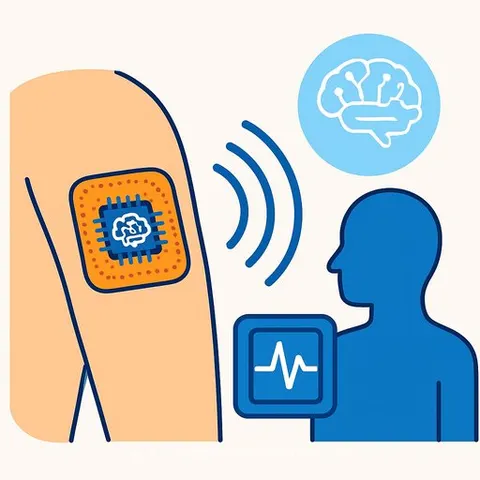
Researchers Create Skin-Like AI Patch That Computes on Your Body
A team at the University of Chicago Pritzker School of Molecular Engineering has built a flexible computing patch that runs artificial intelligence algorithms directly on the body in milliseconds, without sending data to a server. The work, published in Nature Electronics, addresses a critical gap in wearable health devices: the lag time between data collection and analysis can be fatal in some cardiac emergencies.
Today's smartwatches track heart rate and movement but don't analyze the data themselves. That analysis happens on a remote server after wireless transmission. For detecting ventricular fibrillation-a dangerous electrical storm in the heart-even a few seconds of delay is too long.
The Manufacturing Problem
The patch uses organic electrochemical transistors, which process information differently than standard computer chips. They use both electrical current and ions moving through a gel-like electrolyte layer. This gives each transistor built-in memory, similar to how a brain synapse stores learned patterns.
But manufacturing these transistors on flexible surfaces presented a challenge. The flexible substrate is sensitive to heat and solvents, ruling out standard chip production methods. The gel electrolyte also tends to flow like a liquid, merging with neighboring devices and causing short circuits.
The researchers engineered a new polymer gel that hardens into precise patterns when exposed to ultraviolet light. This approach works with photolithography, the standard patterning method used in microelectronics. The result: 10,000 organic electrochemical transistors per square centimeter.
Testing on Real Heart Data
The team tested their stretchable array on a pre-trained algorithm designed to treat ventricular fibrillation more precisely. Instead of a one-size-fits-all defibrillator shock, the approach maps abnormal electrical waves as they move through the heart and delivers small, targeted pulses to stop them.
Using real cardiac mapping data from a donor human heart, the patch located wavefront positions with 99.6% accuracy, even when stretched to more than one and a half times its normal length.
In a separate test, the patch analyzed vital signs and health data-cholesterol, blood sugar, maximum heart rate, and ECG readings-to assess heart attack risk, achieving 83.5% accuracy.
What's Next
The computing array is one component of a larger vision. Researchers are now integrating stretchable wireless communication components and improved sensors to create a fully functional health platform that senses, analyzes, and responds to health data on the body.
For developers and IT professionals, this work demonstrates how edge computing-processing data locally rather than on remote servers-can solve real-world problems where latency matters. Learn more about AI for IT & Development and AI Coding Courses to understand how these systems are built.