
AI news ·
Studies find growing AI reliance erodes professional skills across medicine and software development
AI-assisted endoscopy specialists saw their adenoma detection rate drop from 28.4% to 22.4% when working without AI support months later. In a separate study, software engineers using an AI coding assistant scored 50% on a follow-up quiz compared to 67% for those who worked without AI.
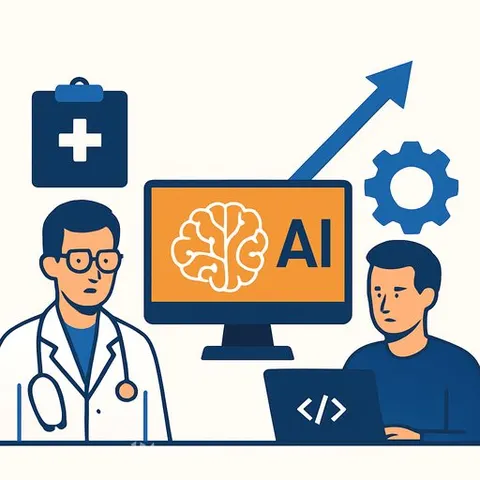
Growing reliance on artificial intelligence tools may be eroding the skills of professionals in fields from medicine to software development, according to recent studies that raise questions about the long-term cost of offloading cognitive work to machines. Researchers point to a phenomenon known as "deskilling," in which people become less capable of performing tasks independently after routinely depending on AI assistance.
One of the clearest examples comes from a study of experienced endoscopy specialists in Poland. Before adopting an AI system designed to flag precancerous lesions in real time, physicians detected at least one adenoma in 28.4% of procedures. After several months of AI use, their detection rate during procedures performed without AI support fell to 22.4%. Researchers said the drop suggests that even highly trained specialists may grow less attentive or less confident in their own judgment once they are accustomed to AI guidance.
Software engineers show similar gaps after AI use
Similar concerns have surfaced in software development. In a randomized study conducted by researchers at Anthropic, 52 software engineers were asked to complete a coding task. Half used an AI assistant, while the others relied only on online resources and documentation. Both groups finished the assignment, but the AI-assisted group performed worse on a follow-up quiz designed to measure what they had absorbed. Those who used AI scored an average of 50%, compared with 67% among participants who completed the task without AI help.
Researchers found that AI users struggled particularly with questions requiring them to identify and diagnose coding errors. The pattern suggests they had not fully absorbed the underlying concepts, even though they produced working code during the task. For professionals in roles where coding with AI is becoming a daily workflow, the findings point to a trade-off between short-term productivity and long-term skill retention.
The cognitive cost of automation
Experts say the issue reflects a broader challenge posed by generative AI systems. Unlike earlier technologies that automated physical or routine tasks, modern AI tools increasingly handle cognitive work such as analysis, interpretation and problem-solving. A previous study of accountants who relied on automated accounting software for more than a decade found that many had forgotten how to perform certain routine tasks when the system was removed, reinforcing a pattern that spans professions.
Researchers note that the effects are not limited to one industry. The same dynamic appears whenever a tool takes over a decision-making step that a professional once owned. The consequence is not just a temporary dip in performance but a gradual, measurable thinning of expertise that can go unnoticed until the technology is taken away.
Why this matters for science and research professionals
For researchers and scientists who increasingly use AI for science and research tasks-from literature reviews to data modeling-the studies serve as a warning about how tool design shapes human judgment. The risk is not that AI will replace expertise outright, but that it may quietly erode the very skills that make a professional valuable when the tool fails, produces unexpected output, or is simply unavailable. Building deliberate, low-stakes practice without AI assistance into daily routines may be one of the simplest ways to preserve the diagnostic and analytical abilities that years of training built.