
AI news ·
Studies show AI chatbots struggle with early medical reasoning when patients seek health advice
32% of adults use AI for health advice, but models fail 80% of the time on early clinical decisions. Clinicians must carefully correct these AI diagnostic guesses.
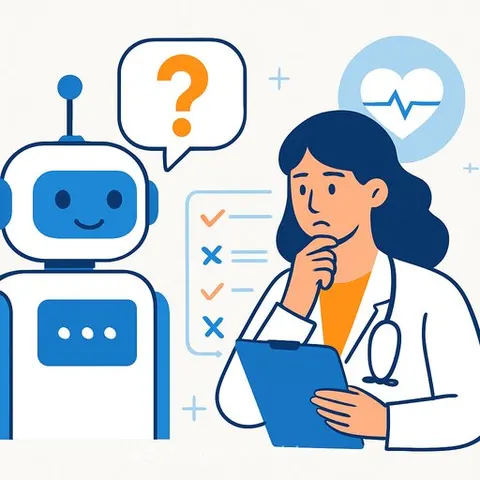
Nearly a third of adults now turn to artificial intelligence for health information, often seeking quick answers to emerging symptoms. For healthcare professionals, this trend means patients are increasingly arriving at clinics with AI-generated diagnostic guesses that require careful clinical correction.
Patient reliance on symptom checkers
A recent KFF poll found that 32 percent of adults use AI for health advice, primarily for immediate answers. Older adults are adopting these tools at similar rates. According to a new AARP survey, 41 percent of adults over 50 who use AI have already asked a health-related question, and 62 percent expect to do so in the coming year. Search engines now automatically generate AI overviews for medical queries, embedding these responses directly into patient research habits.
AI failure in early clinical decision-making
More than 40 million people query ChatGPT daily with health questions, but current models struggle when reasoning is required. A study published in April in JAMA Network Open tested 21 AI tools, including ChatGPT, Claude, and Gemini, on early clinical decision-making. Researchers asked the models to determine which diagnoses to consider before sufficient information was available to confirm one. The tools failed 80 percent of the time.
Dr. Marc Succi, a radiologist at Massachusetts General Hospital and study coauthor, said this is the exact stage when patients are most likely to consult AI. "In fact, more than half of people who use ChatGPT for health questions use it to check or explore symptoms," Succi said.
The need for human oversight
The same study found that AI models performed better once they had all the relevant data. "It's not hard to do well when you have an open-book test, which is how these tools work," Succi said. This dynamic suggests AI can assist physicians but cannot replace them. Relying on an algorithm without clinical review poses a direct risk to patient safety.
"For patients, especially older adults with multiple conditions or medications, the takeaway is not to not use AI; it's to treat AI not like a stand-alone clinician and always get some human eyes on the output," Succi said.
Why this matters for healthcare professionals
Clinicians must adapt to the reality that patients will bring AI-generated symptom assessments to appointments. Healthcare workers should explicitly ask patients what online tools they used before a visit and address those specific outputs. Integrating AI for Healthcare training into clinical workflows can help providers efficiently triage and correct patient-generated AI data, preventing misdiagnoses and reducing unnecessary patient anxiety.