
AI news ·
Study finds 37% of college students use AI monthly, with 9% misusing it to cheat
37% of college students regularly use AI tools like ChatGPT for coursework, with 9% having used AI to cheat, per a Cornell/UC Berkeley study of 95,000 students. Researchers say universities must reform how they assess learning.
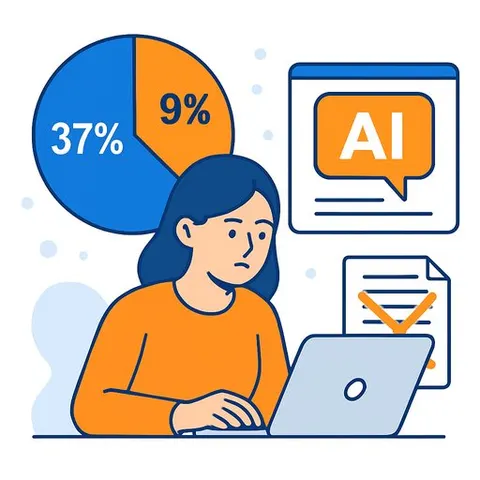
37% of College Students Use AI Monthly, Raising Questions About Academic Assessment
A survey of more than 95,000 students across 20 U.S. public research universities found that more than one-third regularly use generative AI tools like ChatGPT for coursework. The study, published in Science by researchers from Cornell University and UC Berkeley, estimates that 9% of all students have used AI to cheat-a figure that climbs to 26% among daily users.
The findings suggest universities may need to rethink how they measure learning as AI becomes embedded in student work.
Who Uses AI and How Often
Usage patterns vary sharply by field. Computer science students report the highest adoption at 62%, compared with 24% of arts students. The survey, conducted during the 2023-24 academic year, captured the largest dataset to date on this question.
Demographic gaps also emerged. Forty-five percent of male students reported regular AI use versus 33% of female students. Students from underrepresented racial minority groups reported lower adoption rates than white and Asian students. Researchers warned these disparities could widen as AI systems become more specialized and costly.
How Researchers Measured Cheating
Rather than asking students directly whether they cheated-a method prone to underreporting-researchers used list randomization. Respondents indicated how many statements applied to them without identifying which ones. By varying the list content, researchers estimated cheating rates while preserving anonymity.
The 9% overall cheating rate was lower than many anecdotal accounts suggested. But the 26% rate among daily users signals a correlation between frequency of AI use and academic dishonesty.
The Real Problem Isn't Just Cheating
Rene Kizilcec, associate professor of information science at Cornell and director of the Future of Learning Lab, said the core issue extends beyond misuse. "Assessment reform is necessary and urgent," Kizilcec said. "The fact that students are misusing GenAI is a problem for assessment validity, and that's a problem for the credibility of university credentials."
If AI increasingly assists with writing, coding, and analysis, institutions struggle to determine which work reflects student understanding versus AI contribution. Traditional assignments developed before generative AI became commonplace may no longer measure what they're designed to measure.
Three Paths Forward for Universities
Researchers proposed three approaches:
- Return to controlled testing environments-in-person exams with proctors and pen and paper
- Establish clearer rules about acceptable AI use in coursework
- Redesign assignments to incorporate AI tools in ways that reflect real-world professional work
The authors emphasized that restricting AI alone won't solve the problem. Universities must adapt assessments and coursework to account for AI's role in how students learn.
They also flagged that unequal access to AI tools and varying levels of AI literacy among students create additional equity concerns institutions must address.
Kizilcek noted that AI adoption among students will likely continue growing. "As we expect GenAI use among students to only grow, for better and worse, we also expect that GenAI misuse will grow, which is concerning," he said.
The research was conducted by Cornell's Future of Learning Lab and the Student Experience in the Research University Consortium at UC Berkeley, with co-author Ivan Smirnov from the University of Technology Sydney.