
AI news ·
Study finds brief AI use leads to worse performance and lower effort when access is removed
A study of 350 people found that using AI chatbots hurt independent problem-solving - once access was cut, those who had used AI performed worse and quit more often than those who never used it.
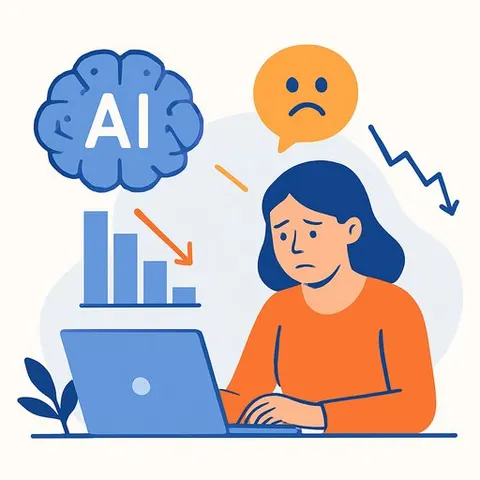
Study Shows AI Assistance Weakens Problem-Solving Ability
People who use AI chatbots to complete tasks perform worse and give up more easily once the AI is removed, according to research involving 350 Americans. The finding raises questions about cognitive costs of relying on generative AI tools for reasoning-intensive work.
Researchers split participants into two groups: one with access to a chatbot, one without. The AI-assisted group initially outperformed the control group. But when researchers cut off AI access mid-test, the results reversed.
After roughly 10 minutes of AI-assisted problem-solving, people who lost access performed worse and abandoned tasks more frequently than those who never used AI at all.
The team replicated the results twice more with larger groups-670 participants in a second experiment, then 200 more on reading comprehension questions. The pattern held across different task types.
"Once the AI is taken away from people, it's not that people are just giving wrong answers. They're also not willing to try without AI," said Rachit Dubey, assistant professor at the University of California, Los Angeles.
Implications for Workforce and Education
The research, published April 7 and not yet peer-reviewed, comes as adoption of generative AI tools accelerates. Microsoft reports that roughly one in six people globally now use AI to learn, work, or solve problems-up from 15.1% in the first half of 2025 to 16.3% by year's end.
Dubey's team cautioned that integrating chatbots into educational programs and workplaces without understanding these cognitive effects could create problems. Workers and students may develop dependency on AI and lose confidence in their own abilities.
The researchers are expanding their work into longer-term studies to understand not just what people can accomplish with AI, but what they can do without it.
For science and research professionals, this work connects to broader questions about generative AI and LLM adoption in knowledge work. The research suggests that performance gains from AI assistance may mask underlying erosion of independent problem-solving skills.