
AI news ·
Study links AI use to lower exam scores and hidden learning loss
A 26,811-student study found AI homework use raised assignment scores 18% but dropped exam results 20%. Managers face similar skill deficits when teams outsource thinking.
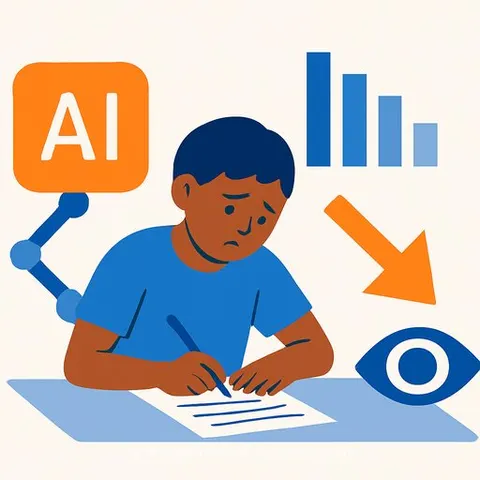
A 30-month study of 26,811 Chinese secondary school students found that using generative AI for homework raised scores by 18% but caused closed-book exam results to drop 20% within six months-and high-stakes college entrance exam scores to fall between 18% and 24% after roughly two years. The same delayed capability gap could already be taking shape in organizations that deploy AI tools widely and rely on output metrics to gauge success.
Researchers observed that about 80% of students used AI in ways consistent with cognitive offloading-finishing assignments quickly, scoring well, then underperforming on exams when the AI was not available. The 20% who did the work without full outsourcing experienced minimal learning loss. For managers evaluating team performance, that 80/20 split is the number that requires attention. A dashboard showing faster task completion and higher throughput might be concealing a growing skills deficit that will not surface until a critical project or an unassisted decision moment arrives.
The hidden cost of AI productivity gains
Homework completion time dropped by nearly a third among AI users, and assignment scores rose 18%. Those gains looked like unambiguous progress. But the researchers found that closed-book exam scores fell 20% within six months. The penalty grew sharper over time, with college entrance exam performance declining by 18 to 24% only after two years of sustained AI use. The damage was not immediate, and it was not visible on the surface.
Wharton professor Ethan Mollick, who has studied AI adoption closely, summarized the finding directly: AI "hurts learning if it undermines mental effort." The study shows that when AI handles the thinking, the brain stops building the capabilities needed to perform the task independently. Information may be accessed, but it does not stick as skill.
Inside a company, the equivalent metrics-documents drafted, tickets closed, reports generated-can follow the same misleading curve. A team might be hitting targets faster while the judgment and problem-solving muscles atrophy. The gap between output metrics and actual capability is a central concern in AI for Management, where superficial gains can mask deeper deficits that compound over quarters.
Cognitive offloading and the skills deficit
Cognitive offloading means transferring mental work to an external tool. In the study, students who offloaded nearly all reasoning to AI passed their homework but failed to retain the material. The same mechanism applies at work. When a manager drafts strategy memos with AI, an analyst generates reports without analyzing data, or a developer accepts code suggestions without troubleshooting, the organization loses the friction that builds expertise.
Leaders who only track output volume or speed invite a quiet decline. The 20% of students who used AI as a supplement rather than a replacement-checking answers, deepening understanding-saw minimal learning loss. In an organizational context, that ratio suggests that unless teams are trained to use AI as a thinking partner rather than a substitute, most workers will drift toward full offloading. Without a deliberate strategy, organizations risk repeating this pattern at scale-something explored in AI for Executives & Strategy.
Why this matters for managers
The study gives managers a concrete diagnostic: track not just what gets done, but what people can do when the tool is removed. Run a project review with AI turned off. Ask a team to explain the reasoning behind a recommendation they generated with AI. If the answers are thin or the team struggles, the capability gap is already growing. The students whose skills held up were the ones who engaged with the material after the AI provided an answer. Managers can build that same habit into reviews, training, and daily workflows. The time to act is before the hidden deficit becomes visible-because by the time it shows up in exam scores, or in a lost client or a failed initiative, the problem has been building for months.