
AI news ·
Sundar Pichai built Google into an AI powerhouse while rivals called for his resignation
Sundar Pichai bet on AI in 2016, built custom chips, kept DeepMind inside Google, and watched it pay off when ChatGPT forced rivals to scramble. Gemini now holds 25% of global AI traffic, up from 6% a year ago.
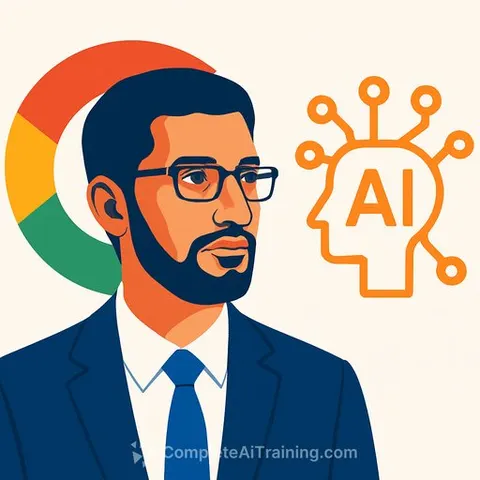
How Sundar Pichai Positioned Google to Win the AI Race
Sundar Pichai spent a decade preparing Google for the AI moment that arrived in late 2022. When OpenAI released ChatGPT and analysts called for his resignation, the Google and Alphabet CEO remained calm. He had already made the bets that would matter: custom chips, cloud infrastructure, YouTube, and deep AI research through DeepMind. All of them paid off.
Gemini, Google's large language model, now accounts for a quarter of AI traffic worldwide, up from 6% a year ago. The company has quietly introduced millions of people to AI through everyday products-search, image generation, video editing, translation, and autonomous driving. Google's cloud division has boomed. In January, the company hit a $4 trillion market capitalization, becoming only the fourth in history to do so.
For product leaders, Pichai's approach offers a lesson in long-term vision and execution. He declared Google would be "AI-first" in 2016, years before the technology felt ready for mainstream use. Most of his peers doubted him. He pushed anyway.
The Product Manager's Instinct
Pichai is not a flashy CEO. He doesn't court media attention like Elon Musk or Sam Altman. His low-key style has sometimes invited underestimation, but it reflects his core strength: an ability to see products as users will experience them.
"He has this ability to fully simulate a product in his head, and how it will be received and used by end customers," says Clay Bavor, a former Google executive who worked under Pichai for a decade. "He has an exceptional sense for craft and the details in a product, all the way down to the pixels on the screen, the sound of a voice, the tactile feedback."
This skill shaped Google's major products. Pichai drove Chrome and Google Drive when senior leaders doubted their viability. He pushed AI recognition into Google Photos and personally tailored keynotes to explain how search would become visual through Google Lens.
When he took over as CEO in 2015, Pichai had already spent time with Google's AI leaders, including Demis Hassabis of DeepMind. In 2016, when DeepMind's AlphaGo made a creative move against world champion Lee Sedol in the board game Go, Pichai understood something crucial: AI could think beyond mimicry. "I understood the potential of the technology to make sharp jumps," he said.
Keeping DeepMind Inside
One decision proved pivotal. After AlphaGo's success, Hassabis wanted to spin DeepMind out as an independent company prioritizing safety over profits. Other Google executives, including co-founder Larry Page, were open to it. Pichai refused.
"I felt a strong conviction that we had to be one team to make sure we are making progress here," Pichai said. "It was so central to the company, I couldn't envision it in my head, intellectually, to think about it any other way."
That choice kept Google's most advanced AI research tethered to product development. When ChatGPT forced Google's hand in late 2022, Pichai was ready to act fast. He combined DeepMind with Google's Brain research team and told employees this was their chance to put life's work in front of billions of people.
Speed Over Perfection
The transition was intense. DeepMind researchers could no longer operate in the abstract. Teams had to collaborate across silos. Employees worked nights and weekends. The early results were rough. When Google rushed out a chatbot in early 2023, it falsely claimed the Webb telescope took the first photo of a planet beyond our solar system. Market value dropped $100 billion in a day.
A year later, Google's AI Overviews in search told a user to eat one small rock a day. The ridicule was real. Pichai wasn't concerned. "Even when we made mistakes, I could see that we were doing many right things," he said.
This reflects his product philosophy: roll out technology gradually, observe real-world behavior, and modify based on feedback. Users become test subjects, but Pichai believes this is better than hiding powerful AI until it's "perfect"-and then deploying it without understanding its actual effects.
Google has done this before. Chrome launched with 1% market share. Google was rarely first to any major product category-web browser, search, email, maps. But distribution, resources, and talent let it close gaps fast.
Building the Stack
What distinguishes Google's position is control across the entire AI stack. The company designs its own chips (TPUs), runs cloud infrastructure, owns the training data (search index and YouTube), employs world-class researchers, and has billions of users to distribute products to.
"Among the existing public companies, they're the best positioned, because they have more pieces than anybody," says Gene Munster, managing partner at Deepwater Asset Management.
Over the past two years, Google's progress has been relentless. Gemini 2.5, released in March 2025, and Gemini 3, in November, outperformed competitors on key benchmarks. More than 2 billion users engage with Google's AI-enhanced search features monthly. Search revenue grew 17% year-over-year in the fourth quarter of 2025. The company crossed $400 billion in annual revenue for the first time.
AI has been integrated into Gmail, Calendar, Maps, Docs, and Photos. Most users aren't seeking out AI-they're encountering it because Pichai embedded it into products they already use.
The Product Leader's Dilemma
Optimizing for user behavior creates tradeoffs that product leaders should understand. If workplaces can deliver goods more cheaply with AI, workers may become expendable. If readers get information from AI overviews, they stop clicking through to publisher websites. Traffic collapses.
In March, a California jury found YouTube liable for harming a young user through addictive design features that contributed to mental-health distress. YouTube was ordered to pay $1.8 million. Similar dynamics have made AI systems dangerously sycophantic. In October, a man who had developed a relationship with Gemini died by suicide after Gemini promised him eternity together. The man's estate sued Google.
When the lawsuit was filed, Google said Gemini had referred the man to a crisis hotline "many times." A month later, the company rolled out new support tools directing users expressing thoughts of suicide or self-harm to crisis resources.
There's also the question of government use. DeepMind's original agreement with Google stipulated its tools could not be used for weapons or surveillance. That language has since been removed. Google has worked with U.S. Immigration and Customs Enforcement and the Israeli government. In February 2025, more than a thousand Google workers signed an open letter demanding the company end partnerships with DHS and ICE.
An additional 100 DeepMind employees signed a letter asking for "red lines" around Gemini's use by the Pentagon for surveilling American citizens or piloting autonomous weapons without human control. Three weeks later, Google announced a deal with the Pentagon to use its AI models for "classified work."
Engineer Alex Samburov, who signed the letter, wrote: "Google's products are used for violent purposes domestically and abroad. I don't want to work for a digital weapons manufacturer."
Pichai's response is consistent: technology should roll out gradually, with real-world feedback informing modifications. "The last thing you want to do is to not use it, not see any of these behaviors, and then just have a powerful model and get surprised," he said.
What's Next
Pichai is already looking beyond current products. Google is developing drone delivery, hologram-like video calls, and AI-powered glasses. The unifying idea is a personalized AI that knows you better than anyone-a universal assistant across phone, laptop, TV, watch, and glasses.
Further out: humanoid robots in every home, data centers in space, and quantum computing breakthroughs for cancer treatment and climate modeling. A decade ago, similar goals sounded like sci-fi corporate hype. They didn't sound that way after Pichai's 2016 AI declaration came true.
For product leaders, the lesson is straightforward: conviction about user needs, combined with the resources to execute, compounds over time. Pichai had both. He also had something rarer-the patience to wait for the moment when the world caught up to his vision.
Learn more about AI strategy and product development: AI for Product Development and Generative AI and LLM resources can help you understand how to integrate AI into products effectively.