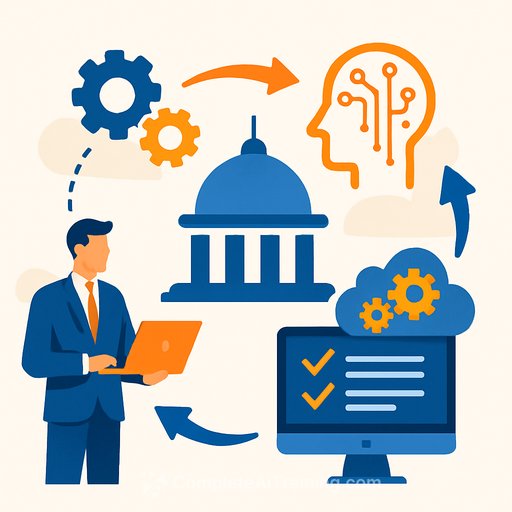
Supercharging IT Service Management With AI and Automation
Mature IT Service Management (ITSM) is vital for improving service delivery and efficiency in state and local government agencies. Many agencies face challenges such as outdated legacy systems, manual workflows, and disconnected monitoring tools. Modern ITSM addresses these issues by introducing automation and self-service capabilities.
Resource constraints remain a significant obstacle for IT leaders. Supporting hundreds of applications without additional staff makes managing workloads difficult. Advanced ITSM platforms that combine automation, integration, and conversational AI equip IT teams to handle complexity and rising user demands while enhancing service quality for both agency employees and the public.
Why ITSM Maturity Matters
Mature ITSM strategies improve government technology services by delivering:
- Greater efficiency. Automation and integration streamline workflows, cutting down delays and errors. By automating routine tasks, IT teams can concentrate on strategic priorities.
- Increased productivity. Self-service portals enable users to resolve common requests like password resets without IT involvement, speeding up service delivery and reducing downtime.
- Improved user experience. Consistent, transparent service builds trust. For instance, modern ITSM platforms provide timely updates on ticket statuses instead of leaving users uncertain about progress.
Government agencies recognize these benefits. A late 2023 survey by the Center for Digital Government found nearly 60% of state and local agencies plan to automate ITSM workflows. IT staff currently spend 5–10 hours weekly on repetitive manual tasks, and automation could save months of effort annually even in small teams.
However, many agencies still rely on standalone tools and have yet to fully adopt mature ITSM practices. About half have standardized incident management, fewer have strong change management, and even fewer offer self-service options. These gaps represent opportunities to improve by adopting comprehensive ITSM platforms that unify multiple service functions.
Transforming ITSM With Automation
Automation is key to efficient ITSM. It reduces manual workloads and frees IT staff to focus on innovation. Self-service portals can handle up to 80% of routine IT requests, accelerating resolution times and easing pressure on support teams.
Despite its advantages, automation adoption in government IT remains limited. Only 20% of surveyed agencies have fully automated common ITSM functions. Small IT teams, common in local government, benefit greatly from automating onboarding, password resets, software provisioning, and equipment requests.
Automation also helps manage the complexity of supporting numerous applications. Nearly half of state and local IT departments handle more than 50 applications, with many managing over 100. Automation supports efficient service delivery amid this scale.
The Power of Integration
Integration is essential for mature ITSM. Platforms with built-in connectors link various government systems, creating seamless workflows across departments. Common integrations include:
- Tyler MUNIS for enterprise data
- Workday for HR synchronization during onboarding and offboarding
- Microsoft Office 365 for calendars, emails, and Teams communication
- Amazon Web Services and Microsoft Azure for cloud management
These integrations enable faster response times by automating ticket generation and closure, eliminating manual steps. Centralized data and workflows improve visibility, accuracy, and strategic planning at the enterprise level.
Elevating ITSM With Conversational AI
Conversational AI enhances self-service portals and automation by offering intuitive, language-based interactions. AI chatbots can guide users through simple tasks like password changes or checking request status, reducing support tickets.
Some agencies extend AI chatbots to handle complex, multistep requests by integrating with finance, HR, and facilities systems. For example, a chatbot can verify software eligibility, process installation requests, and execute the installation without IT staff involvement.
Choosing an ITSM Platform
IT leaders should consider several factors when selecting an ITSM platform:
- Low administrative overhead. Tools should be intuitive, allowing staff to create and update workflows without advanced technical skills.
- Agility. The platform must adapt quickly to new requirements or policy changes, such as remote onboarding or equipment delivery.
- Ease of creating complex workflows. No-code interfaces enable non-technical users to automate multistep processes, reducing reliance on developers.
- Ease of integration. Prebuilt connectors for existing technologies simplify workflow management and cross-department coordination.
Benefits of Modern ITSM
To justify ITSM investments, leaders should track and communicate measurable benefits:
- More efficiency and capacity. Faster ticket resolution and increased IT availability for strategic projects.
- Improved employee productivity and morale. Quick issue resolution keeps employees productive, while automating mundane tasks improves IT staff satisfaction and retention.
- Enhanced constituent satisfaction. Reliable, consistent service with proactive updates builds trust and transparency.
- Cost savings. Reduced labor for routine tasks and consolidation of tools lowers overhead and eliminates redundant systems.
As one experienced IT leader noted, empowering staff to focus on meaningful, challenging work rather than repetitive tasks drives engagement and value within IT organizations.
Foundation for Success
Adopting mature ITSM transforms how agencies manage technology services. Leveraging automation, integration, and conversational AI strengthens performance, reliability, and service quality. Choosing platforms that grow with organizational needs positions agencies to meet evolving expectations effectively.
For those interested in advancing ITSM skills and AI automation, exploring relevant training can provide practical knowledge and tools to support these initiatives. Check out comprehensive AI courses to build expertise in automation and IT service management at Complete AI Training.
Your membership also unlocks: